
And so it goes on; ‘it’ being the reaction in one section of the Church of England to what are called “the faithless LLF proposals”, produced by the “unorthodox” House of Bishops, aka our “compromised leadership”, etc etc. This really does drag on, and it is only too easy to forget that Synod has consistently voted in favour of some movement. Not equal marriage, but some acknowledgement of the faithful relationships of the lesbian and gay couples in our church, relationships acknowledged by the state. While the opposition to using the very bland Prayers of Love and Faith in stand-alone services, and to allowing clergy to enter same-sex civil marriages, comes from various different strands of the Church of England, all the quotes above originate in the conservative evangelical tradition: specifically, the 24 July commissioning “of leaders” service which happened at St Helen’s Bishopsgate.
Let’s backtrack for a moment. That service followed another “commissioning”, this time of the first set of “alternative spiritual overseers” (ASOs) by the Church of England Evangelical Council (CEEC) on 12 July at All Souls Langham Place. The c-word seems to be doing a lot of work here. The 24 July “commissioning of leaders” looked initially like it was part 2 of those events, with the video from St Helen’s Bishopsgate stating, “Yesterday’s commissioning is the second of its kind”. But that’s confusing, because 24 July wasn’t about commissioning ‘overseers’ at all. So, “second of its kind” in the sense of ‘second action by those who believe gay relationships are sin’, rather than ‘second batch of ASOs’?
Perhaps not. Among the riches of YouTube you can find the commissioning service for George Diwakar on 30 August 2023, also held at St Helen’s Bishopsgate. If you have other things to do today, well, you could watch the short intro here. In the full version, the rector of St Helen’s Bishopsgate, William Taylor, talks about “the failure of the leadership in the Church of England”. Recommended for training by the Church of England and trained at Oak Hill, George, we are told, decided to “press pause” on ordination and instead to be “commissioned as a minister of God’s word” to serve at St Helen’s Bishopsgate, under the New City Deanery Chapter. (What’s that? It’s a new thing: 11 clergy from 7 churches in a self-appointed alternative deanery structure set up to “differentiate” these clergy from the bishops in the Church of England who are “decisively departing from the word of God on a matter of salvation”). George talks about losing the sense of security of the C of E pathway but says how much better it is not to worry about having to answer to God for being ordained by somebody “who was turning against God’s word”. The final prayers of the service ask that Bishop Sarah may be given “courage to stand and to come back to your word”. Mutual flourishing, anyone? The vimeo version of this service uses as its key image the kneeling George with various leaders laying hands on him (4 mins 26 seconds in). It does look a lot like an ordination. And we are told that George will be followed by others “waiting in the wings”.
Oak Hill, by the way. Still not within the Durham Common Awards framework, despite more than one Periodic External Review (PER) since 2016 challenging its refusal to join, and despite the message from reviews that this requires “serious and urgent attention”, and so making this college ideally placed to be the theological college of choice for those who want to keep themselves pure from the rest of the Church of England. As an added bonus for those parts of the church uneasy about women in ministry, as the March 2022 PER noted, “Most students are white, male, and educated. Currently there is 1 female ordinand and 15 female students overall (14%)”. But Oak Hill is perhaps not staying as pure as all that; in April 2024 they announced that they were taking the plunge into Common Awards, not least because their validating university, Middlesex, will end its relationship with them at the end of the 2024-25 academic year.
The person who talks us through most of the 24 July video is again William Taylor, who was also listed in the 12 July order of service as someone to be commissioned as an ASO at a later date. There’s no indication that he has been commissioned in between the two services. So he is clearly ‘in’ the ASO-making group; otherwise, one may well wonder whether the two services were being organised by slightly different groups?
Back to that 12 July service at All Souls Langham Place. This was about “commissioning” their own selection of ordained men and women (not many women, just two out of 20 – because, of course, conservative evangelicals are one of the groups in the Church of England which doesn’t agree that women can be ordained). Some are priests, some are bishops. It was a CEEC-run event; not an Alliance-run event, and that is interesting when the Alliance – a broader “informal partnership of leaders from networks within the Church of England” includes the CEEC but also includes traditional Catholics. Maybe not everyone in the Alliance was quite so happy about this “commissioning”.
The commissioned ASOs are an interesting bunch. Mostly retired men, mostly from the South, from Canterbury province rather than York. All White. One of the ‘overseers’ is the Bishop of Ebbsfleet, who is already a ‘flying bishop’, one of those appointed to offer episcopal oversight to those in the C of E who hold the theological conviction that women cannot be priests or bishops. I’m not sure how the role overlap is supposed to work.
Another is Bishop Rod Thomas, an ex-flying bishop, as from 2015 until his retirement in 2022 he was the Bishop of Maidstone. He started out in the Exclusive Plymouth Brethren. He has said he left because of “the destructive effect it has on families”, and it gave him “a lifelong love of the tolerance you find in the Church of England”. Tolerance, eh? We may be defining that differently.
Bishop Rod entered the Church of England via Emmanuel Church, Wimbledon (ECW). That’s, shall I say, an unfortunate link, bearing in mind that the former vicar there, Jonathan Fletcher, is not a model for good safeguarding (the intro to the 12 July order of service made it clear that the ASOs are committed to “working within the Church of England’s safeguarding framework”). Indeed, Fletcher was identified as a model of “gross abuse of power”, to quote the thirtyone:eight report on him issued in 2021. Bishop Rod has stated that he began going to ECW a year before Fletcher arrived – so that would be 1981 – and left in 1991, but stayed part of Fletcher’s ‘preaching group’; he has said that he knew about what Fletcher was doing in 2018 and left the preaching group in the following year. Last month, Fletcher was charged with historical sex offences for the period 1973-1999.
I am not linking Bishop Rod to safeguarding failures; indeed, he offered to resign as Bishop of Maidstone, if Archbishop Justin Welby felt he had acted inappropriately, but the Archbishop declined to accept the resignation. But it is worth pointing out that ECW, where his faith was formed, was a church where what thirtyone:eights called the “celebration of masculine Christianity” was “embedded in the lives of many”, and where “the culture of leadership on a pedestal” meant that abuse was not reported for fear of “the impact on the wider community if behaviours were exposed”.
The conservative evangelical world is a tightly-knit one, where networks overlap and where the same names turn up over decades. When the Fletcher situation was in a particularly difficult phase, in April 2019, Rod Thomas and William Taylor were two of the four ordained ministers who wrote to the regional coordinators of their network to let them know that Fletcher no longer had Permission to Officiate: and the letter mentioned how “Jonathan … continues to be held in great affection by many”. I do wonder what level of abuse it takes before the affection wanes.
Back to the “commissioning”. The order of service suggests it was done by the congregation, who all stretched out their hands to the candidates “as a sign of prayer and commissioning”. In contrast, for the later service on 24 July, there are images of the candidates with selected hands being laid on them, like this one. Looks rather like a confirmation to me? Or maybe an ordination?
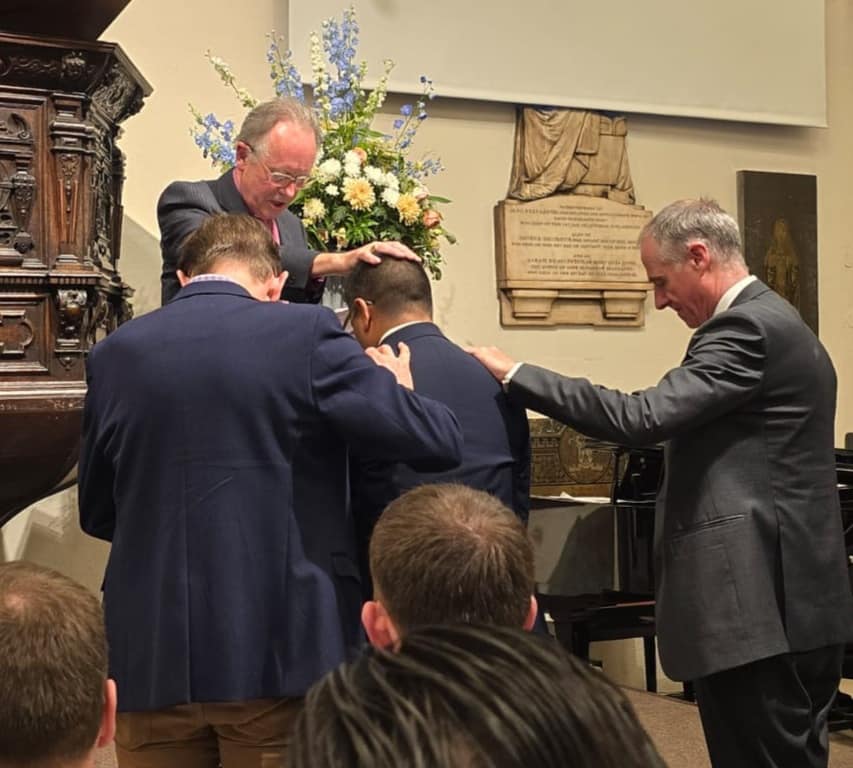
In the flurry of statements after the 12 July event, I felt that CEEC was giving us a certain amount of ‘Nothing to see here. Move along’. “Overseer” Bishop Henry Scriven “didn’t see it as massively a big deal”. A similar downplaying came from the ‘LLF bishop’, Bishop Martyn Snow, interviewed on Radio 4; it is just “an alternative support structure”, one of many. The CEEC statement “stressed that the liturgy is neither a service of ordination nor consecration”. Oh that’s all right then…
But come on, this is disingenuous. And it’s not even consistent because, alongside that, there was also the claim that the July 2024 Synod vote on LLF represented “milestone day”. I’m not convinced by that either – surely such a milestone, such a crossing, happened when the Prayers of Love and Faith were formally commended by the bishops in December 2023, or at one of the many – so many – debates on LLF we’ve been through in the last four years? GS2328 – an “overview of the progress made in implementing what was agreed at the February 2023” Synod, debated in November 2023 – was a “watershed for many” according to the CEEC, wording also quoted in the document outlining the background to the service.
How many watersheds can you have? Which milestone is the one that makes the difference? Surely if you believe that all relationships between people of the same sex are sinful, then – getting classical here for a moment – the Rubicon was crossed a while back, not least with the bishops commending the Prayers of Love and Faith to be used in existing services. To me, the July 2024 Synod debate felt more like groundhog day. And the recent statements about both the 12 July service and the one on 24 July make if very clear that they were scheduled to happen whichever way the Synod voted in July; the 24 July video includes Charlie Skrine talking from York General Synod the day after the LLF debate had taken place. “Overseers” had been chosen, venues booked: it was all planned at that point.
Which brings me back to that 24 July service at St Helen’s Bishopsgate. This was not about overseers, but about seven men, described in the publicity as “young”, who were publicly commissioned for church leadership. So it is more like the events of 30 August last year. On the video about the 24 July service, Jon Tuckwell describes them as having been “carefully selected and trained for ministry”. When I first heard that I wondered if the “overseers” (or the selection panel who chose them) were involved. But the more I’ve thought about it, the more I’ve wondered whether these are all men who, like George Diwakar, have been in the selection and training process of the Church of England but have decided not to be continue in that process – perhaps seven of the 78 whose names were behind a letter sent by “Orthodox Ordinands” in October 2023. In that letter, they said they “anticipate[d] fracturing across the Church of England”; well, of course they did, because the plans for ‘fracture’ already existed and the “overseers” official announcement was in early December. This was not a spontaneous fracture.
What sort of church leadership are these seven men entering? The service on 24 July was definitely not an ordination (the video mentions the need, though, to “provide a pathway for full ordination” and “in due course ordination services”, and conveniently the “overseers” include various bishops who could ordain…) and they were commissioned as lay people.
But now it gets confusing. What sort of lay ministry are they in? If it’s Licensed Lay Ministry, there’s a formal process for that which involves your bishop – it isn’t something churches make up as they go along. There’s a formal process of regular ministerial development reviews. There are other types of lay ministry which are authorised rather than licensed but, again, the bishop is part of the process. There are also “Recognised Ministries” where the parish is responsible for the selection, recognition and training, and these need a person as named supervisor, as well as regular reviews.
I’m not the only one confused here. Anglican Futures has listed ten questions about the 24 July service, here. Specifically, the Anglican Futures team raise issues around canon law, and also think that the video about this service misrepresents the position of the CEEC.
If I am right and the selection and training of these first seven men happened, like that of George Diwakar, in mainstream C of E practices, that doesn’t work with the statement on the video that “Another selection panel is being formed for selecting more men and women. St Helen’s will now only send people forward” through this new route. So that’s just one church – a very large one, sure, but just one – opting out of the C of E selection processes? Where will these people be trained? Who will pay for them?
“And women”, eh? What I heard as the rather arch tone used here was also interesting. St Helen’s only has women on the team as Women’s Workers or a Youth Worker or a children’s worker (by the way, George Diwakar is listed as “Associate training”. Not sure what that means). The church has a complementarian theology. Yet the young men commissioned are – according to William Taylor’s video – apparently going to be leading “informal church family meals at which bread is broken and the death of the Lord Jesus is remembered” (not communion services, oh no, what with them being lay not clergy) in the churches that St Helen’s has planted. Do women do this too, I wonder? Or would the women selected for this new sort of ministry only be allowed to work with women and children? What about an all-women “informal church meal”; could women break bread at that? And how do the traditional Catholic members of the Alliance think about this, in terms of sacrament?
So, is there anything to see here, or just a group of like-minded people officially designating some of their friends as people to whom they can go for a pastoral conversation (12 July) and a parish-level event (24 July)?
It’s hard to tell. It could be a damp squib: it could be the initial step that leads to schism, the first stages of a new province (except, of course, that would need parliamentary legislation – it is not a matter of saying ‘Hello, we are a new province’). Will any bishop or archbishop challenge what happened at All Souls Langham Place and at St Helen’s Bishopsgate?
But there’s one more thing I observe here. Those who are involved are also – as far as I know – continuing in the ‘LLF process’. Isn’t that rather odd, when they are very clear that there is no compromise that will ever be acceptable to them? Even after his retirement, Bishop Rod Thomas was a member of the “Next Steps Group”, one of the many different stages of this process – and yet here he is, becoming an ‘overseer’. John Dunnett of CEEC was part of the ‘facilitated group discussions’ in September 2023 (so was I) and he is one of the members of the Pastoral Provision group of the current Working Groups. He has unequivocally called for ‘differentiation’. The Alliance folk at those September meetings insisted on such separation from everyone else, even while the liberal/progressive folk were trying to find ways to make them feel able to stay in the C of E; for example, by being willing to go for an ‘opt-in’ system where parishes have to agree to offer the Prayers of Love and Faith, rather than having it as the norm, which would have put the onus on those who want to opt out. John stated at the end of 2022 that the “level of security that is needed for orthodoxy to flourish permanently within the Church of England” requires either a ‘Third Province’ where liberals can be put, or having “a new province for orthodoxy”. We went through all this Third Province thing over the ministry of women, and it went nowhere.
So is it any wonder that all these discussions go round and round, when they have in them people who are happy not just to be prominently associated with public events that aim at separation, but to host them and speak at them?

 sharedconversations
The photo shows an ordination – ordination is by laying on of hands and prayer. At the admission of Readers (LLMs), bishops are careful not to lay on hands. The problem is that these folk are generally a bit clueless about liturgical theology – not true of all of them by the way as Pete Broadbent is well thought out on such matters even if you don’t agree with him. I could advise them and waive my usually fee if they made a financial donation to Inclusive Evangelicals….
LikeLike
That ignorance of liturgical theology is, sadly, widespread. In this diocese it is usual for hands to be laid and anointing to take place at licensing services.
LikeLike
I can offer a generous discount in such emergencies
LikeLike
Pingback: Religion news 1 August 2024 - Religion Media Centre
Pingback: The Third Province: Welcome to Mercia | sharedconversations