Too many adjectives?

One of my husband’s pet hates when we eat out is when a menu has too many adjectives, to the point that you almost lose sight of what it is you’re eating: ‘smoky deep-fried maple-cured lightly chopped British bacon’, that sort of thing. There are – of course – even websites like this one which can help you plump up your menu.

Here’s a little Church of England example from the just-released document GS2303, Implementation Work for Living in Love and Faith, which sort of is and sort of is not on the agenda for the July 2023 Synod (more on its status later): it announces itself as a paper which ‘outlines the update presented to General Synod in July 2023’ (which seems odd when the meeting hasn’t happened yet). In paragraph 20, 

There was also a commitment to provide a generous pastoral response which is loving and celebratory to those who are in life-long monogamous same-sex committed relationships

Now I can see what they are doing there. It goes with paragraph 12, which comes from a different one of the three ‘implementation groups’ which have been working on all this since February. Paragraph 12 tells us that the various groups are considering ‘in which situations the Prayers of Love and Faith will be recommended for use and what conditions may be imposed on them, such as that they may only be used with those whose relationship is demonstrably faithful, exclusive and permanent’.

So those four adjectives qualifying the word ‘relationships’ are trying to capture that combination of conditions.

But here’s a question. Do those who preside at marriages of straight couples check out where their relationship stands on these qualities? How do you ‘demonstrate’ that your relationship ticks the boxes, particularly if you are in the minority of couples who haven’t entered a physical relationship yet? Who is doing the checking?

I’m assuming that ‘in life-long monogamous same-sex committed relationships’ is Church code for those who entered civil marriage or civil partnership a while ago and now want the church to bless this. But if you would like to be married in church, can’t because that’s not allowed, and so ask for prayers immediately after your civil ceremony, are you still allowed to have these prayers?

Then there’s that ‘life-long’. How do you know your marriage is life-long? Maybe the word ‘intended’ should be in there somewhere. As many have pointed out, the claim that the only real marriages are those ‘between a man and a woman, for life’ already encounters a problem when faced with people who marry after a previous divorce. The Church of England allows them to marry in church, after interviews with the vicar, and also allows vicars who literally the ‘for life’ to refuse to marry a couple like this.

Perhaps the most interesting throwaway line in GS2303 is in paragraph 27. This says that one of the three ‘implementation groups’, the Pastoral Reassurance group, are ‘considering structural approaches where they are congruent with the Pastoral Principles, where they maximise mutual working together and seek the Gospel imperative for the Church to be one’. I had understood that the bishops were very much opposed to the calls for ‘structural differentiation’ being made by conservative evangelicals, whether these were for separate bishops, a separate province, their own theological training and their own ordinations. Yet here is the ‘s’ word. Somehow, in the topsy-turvy world of the Church of England, where ‘next steps’ means standing still and ‘implementation’ means not doing anything, ‘differentiation’ is about being united.

Finally, is GS2303 actually on the agenda for July? We are told that it’s not ‘part of the formal Group of Sessions (and therefore [does] not form part of the Agenda)’. This means it is not covered by Standing Orders. We are told that there will be a Notice Paper about it, and it will be ‘explained’ when we get to York. Yet the original published Agenda included ‘Living in Love and Faith’ with GS2303 as the supporting document. The item is scheduled for the Saturday afternoon, after a diocesan synod motion on prisoner rehabilitation. Assuming that motion would take a maximum of an hour and a half, that would mean 15.45-19.00 for LLF, which suggests there’s more happening than the Bishop of London summarising the 38 pages of GS2303, most of which in any case are the revised, very bland, prayers to use for covenanted friendship, God’s blessing, or a household or family.

The Business Committee’s report on the agenda says that the item is ‘a presentation and opportunity for questions’. I shall certainly have some of those…

Posted in equal marriage, General Synod, Living in Love and Faith, Shared Conversations | Tagged , , , | 1 Comment

Correcting the Record: Safeguarding

(addendum added 20 June)

OK, this is going to sound technical, but it matters, particularly as this concerns safeguarding.

First, the context. Once you are on General Synod, all sorts of strange things happen. You have the opportunity to ask a formal, public ‘Question’ for which a written answer is supplied in advance, and then a supplementary to which the answer, given in person, will then appear in the record of the meeting.

As a result of a Question I asked in February 2023, I now know there may be another stage: when you are informed that the answer to the supplementary was wrong. But what happens then? How do other people find out that it was wrong?

A warning: if you want to know what happened at Synod, I wouldn’t rely on the site claiming to be a ‘Record of past meetings’ with its list of ‘Reports of Proceedings’. As of two days ago, that only went up to July 2022, although now it includes February; the result of someone writing in to ask that this be organised more transparently. In general I’ve found one is better off with this one, then go down to each Synod meeting listed, and scroll down until you reach ‘Business done, voting results and report of proceedings’. It isn’t easy to find anything unless you know already where it will be, or you have a useful key word for which to search.

If you work your way through the material for the February 2023 Synod, you’ll find there, under Question 56, that I asked whether the Independent Safeguarding Board has been ‘subject to scrutiny by the Audit Committee of the Archbishops’ Council in relation to its formation and operation and, if so, with what outcome?’ The question was addressed to the Presidents of the Archbishops’ Council but was answered on their behalf by Maureen Cole (the Chair of the Archbishops’ Council Audit Committee). She said no, it had not been subject to scrutiny, and added that the Archbishops’ Council ‘receives regular updates on safeguarding matters, including with regard to the work of the ISB’.

I then asked a supplementary picking up the answer to an earlier question on the independence of the ISB: ‘As the answer to question 49 clarified, the Archbishops’ Council created and paid for the ISB and so, as the Audit Committee has the power to request an audit of the board’s operation, have its members requested this and, if so, with what results?’ Maureen Cole replied: ‘We do not have the ability. We are not the Audit Committee of the ISB. We are the Audit Committee of the Archbishops’ Council. The thing that we can do and we have got included in the safeguarding risk is actually the governance and set-up. Archbishops’ Council are monitoring this situation, so we have to wait and see.’ I was also supported by Ian Paul (House of Clergy) and Clive Billenness (House of Laity), both of whom are members of the Audit Committee, who intervened to clarify the point that members of that Committee had asked to review the ISB, but this had been declined by the Archbishops’ Council.

But was that the end of the matter? No. 

On 1 March William Nye, the Secretary-General, forwarded to me a letter from Mrs Cole, with the same date, making a correction to the answer she gave. I thanked him, and asked whether this correction would be sent to members – the answer was that this is not routinely done when an answer needs correcting, and it would not be done in this case. However, an annex would be added when the proceedings of the February 2023 meeting were published. They are now online – I don’t know when they went up – but there is no sign of the annex. Perhaps it is buried so deeply that I can’t locate it; the Church of England website has become increasingly unfriendly even to the casual user.

So, for the record, here is what Mrs Cole wanted to say as the amended version (I have emboldened what I think are the most significant points):

When you asked in your supplementary about the power of the Archbishops’ Council’s Audit Committee to audit the work of the Independent Safeguarding Board, I replied that the Audit Committee did not have the ability to do that, as it is the Audit Committee of the Archbishops’ Council, not the Audit Committee of the ISB. At the time I gave the answer, I gave it in good faith, believing that the Audit Committee did not have that ability.

However, I have since looked into this matter further, and examined the arrangements under which the ISB operates during its present phase of work. They are as set out by Jamie Harrison in his answer to Question 49, to which you made reference. The members of the ISB currently operate as contractors to the Archbishops’ Council; but I was not familiar with this at the point when I answered your supplementary question. As a result of my follow up since Synod, I now realise that I have should have said that the AC’s Audit Committee does have the ability to commission an internal audit of all or of aspects of the work of the ISB, but that it has not done so. In answer to your specific question about members of the Audit Committee asking that there be such an audit, yes, it is the case that some Audit Committee members have suggested this. But we have not included such an internal audit in our audit plan for the Archbishops’ Council. The Council’s director of risk and assurance does not consider that, considering the degree of risk involved, it should be a priority for inclusion in the Council’s audit plan. However, this is an issue which the Council’s Audit Committee can keep under review.

It may be helpful if I add, for the avoidance of doubt, that the answers to the questions, and my clarification above, relate to internal audit. As to external audit, it is of course the case that the Archbishops’ Council’s expenditure on the work of the ISB will be subject to audit by our external auditors, just like any other item of AC spending. I do not suppose that that is what you had in mind, but I just wanted to clarify that distinction.

I am sorry not to have given a fully accurate answer to your supplementary question, but my answer was given in good faith, and I am happy to correct it.

William Nye assured me in two separate emails on 6 March and 17 April that this would appear as an annex to the February 2023 Proceedings. So far, it does not. It’s probably an oversight, but it’s an odd one, after the amount of correspondence I’ve had since February. Considering that safeguarding is rightly in the public eye at the moment, it worries me.

Addendum:

Following this blog post being brought to his attention, William Nye wrote to me again on 20 June. He stated that “It was an administrative error that the wrong version was uploaded to the website. But I am sorry both that the mistake was made, and also that you had to chase us about it again. Having discovered, via your blog, that we had uploaded the wrong version, I asked staff to correct this, and you will now find an up-to-date version on the website. Here is a link: Updated Report of proceedings Feb 2023.pdf (churchofengland.org) I, and the Synod Team, are sorry that this error was made.  I will take the opportunity to remind staff about the importance of timely and accurate corrections.”

As the Report still doesn’t have pagination throughout, it remains tricky to find my original question (the Search feature is the answer) and the correction to the blog appears on an unnumbered page immediately after p.221.

Posted in Shared Conversations | Tagged , , | 1 Comment

Revenge of the Sticky Notes

[image: ProjectManhattan, Sticky Notes on the Wall, https://commons.wikimedia.org/wiki/File:Sticky_Notes_2.jpg%5D

The Church of England does love its sticky notes: the paper ones, not the online version. On my Parochial Church Council we are still living with the results of a sticky-note exercise many years ago which led to the formation of the various sub-groups which meet between full PCC meetings and are supposed to do the real work. And the sticky notes have reared their multicoloured heads many times in the processes designed to help us work out where we should go with inclusion of LGBTQIA+ people – first the Diocesan Shared Conversations and then Living in Love and Faith. In the Shared Conversations we had giant-sized ones which eventually spread all over the walls of the main room where our residential event took place. In Living in Love and Faith, the very first meeting of the fledgling History Group involved us all writing down what we hoped we’d feel at the end of the process. I don’t think the present situation, after the February General Synod, counts as ‘the end’, but for the record, what I wrote was that everyone would feel their point of view was represented fairly in the final documents.

Why sticky notes? Well, they are a way of making sure that everyone can contribute – not just those who shout the loudest. They can be anonymous so you can say what you think, assuming your handwriting isn’t distinctive. You can move them around easily to identify emerging themes. But that can be difficult and can be influenced by the preconceptions of the person doing the moving around. If you ask people to write ‘just one word which sums up…’ you can bet that some of them will write two words, or three, or a phrase. The trouble with the small ones is that writing just a word or phrase may miss any nuances. The trouble with the large ones (you can get some which are 279 x 279 mm) is that they encourage people to write an essay. And in any case what happens to them after the event? Does anyone go back to check them or are they stored in folders somewhere?

After the most recent College of Bishops meeting, there was a rumour that a bishop had posted on Twitter a photograph of Dr Eeva John, who as its Enabling Officer had held the LLF process together, holding flowers marking the end of her role with LLF, and that the photograph had disappeared rapidly because it also showed a raft of sticky notes which were presumably not supposed to be shared more widely. On 4 April, anglican.ink shared it regardless, and deciphered some of the handwriting. The journalist there concluded that the notes showed that ‘the LLF process has landed the Church of England on the rocks’, which seems an odd comment when sexuality has been discussed for over forty years and the LLF book – despite its flaws – has done a good job in charting the range of beliefs which currently exist within the C of E. Maybe it’s more that the LLF process has made us face the reality of our divisions on sexuality. Considering how long we spent on writing the main book, and how many of us kept insisting that it had to cover far more than the specific question of whether same-sex marriages could happen in church, it is depressing that everything has narrowed down to that, or more accurately to a resource of prayers which include some which could be used with a couple who had entered a same-sex civil marriage or civil partnership.

Because these episcopal discussions were private, we have no idea whether there were other boards on which the more positive comments were collected. Are the notes behind Dr John the result of grouping, or a random brain dump? We don’t know. As Marcus Green wrote in 2020, she was ‘dealt an unplayable hand’ but still did ‘a terrific job’. In 2021 she was awarded a Lambeth doctorate for her work on LLF. It is depressing that this final image of her extraordinary work gives the impression of unremitting gloom.

Leaving aside the highly creative things you can do with enough sticky notes, such as the Extreme Sticky Notes Experiments (these used nearly 300,000 of the things – I wonder how many the C of E uses every year?), what do you do to make people think beyond their gut reactions? We seem to be regressing at the moment into precisely those caricatures of our fellow Christians which LLF was intended to move beyond. At a College of Bishops residential which I attended in my History Group role, I walked past some posters on which bishops had been asked to put their comments using De Bono’s ‘Thinking Hats’ method. At the Shared Conversations, I was impressed by some of the exercises we did, which I described here. When watching some training being offered in another diocese, I came across the ‘Fruit or Chocolate?’ exercise I described here. Rather than sitting writing sticky notes, these exercises involve interaction with other people, working with them, beginning to know them, learning from them and, most importantly, coming to trust them. And at the moment, it doesn’t feel like that is happening at all.

Posted in equal marriage, Living in Love and Faith, Shared Conversations | Tagged , , | 1 Comment

February 2023 General Synod: sex, sin and separation

Here is the story of ‘my’ Synod experience, for the record. Sorry it’s long but there was a lot of it. My take-home points would be that it is clear that conservatives are now focusing on two battles: to defend ‘sex is only in marriage and gay people can’t be married so gay people can’t have sex’ (whatever sex means) and the quest for a separate branch of the Church of England in which they can be kept safe from the rest of us. If being in communion with people who, in their terms, ‘bless sin’ is such a risk to their own salvation, then I really can’t see how any level of unity will be possible. We can’t both be ‘the Church of England’. And, bearing in mind – as the Bishop of Reading, Olivia, has pointed out, most congregations include people with a range of views on equal marriage.

For clarity, we passed (57% voting in favour) the bishops’ motion which repented of ‘the failure of the Church to welcome LGBTQI+ people and the harm that LGBTQI+ people have experienced and continue to experience in the life of the Church’, commended the LLF process and the Pastoral Principles, welcomed the bishops’ decision to replace Issues in Human Sexuality and welcomed more work on the prayers which include some that could be used (if the priest agrees) with same-sex couples in civil partnerships and civil marriages. Those prayers will come back to the July Synod. This will be a tiny, tiny change, when it comes. An amendment reinforced that the doctrine of marriage is not changed.

Monday was fine; good speech from the Archbishop of Canterbury, and the Bishop of London gave a thoughtful address introducing the Living in Love and Faith work for this session. The Questions session was good and (amazingly!) we got through all the Questions; the ones I had asked around safeguarding received interesting answers and I was able to ask my supplementaries. Off the agenda, an emergency meeting of the St Hugh’s Conversation – the group set up by the Bishop of Oxford three years ago to bring together prominent liberals and conservatives and to which I belong as a result of my position as vice-chair of the Gender & Sexuality Group – was called to discuss whether members want to propose in the debate the conservatives’ aim for ‘structural differentiation’ (separate bishops, separate training, separate ordinations, maybe difference provinces). This was inconclusive. In the evening, the Gender & Sexuality Group joined with Affirming Catholics in Synod, WATCH and the Evangelical Forum for an event at St Martin in the Fields. After eating together we heard short talks from a range of members including two bishops, all of us united in welcoming the new draft prayers which include some to use with a couple who have had a civil marriage or civil partnership. The closing service of Compline was very moving. There were nearly 200 people present.

Tuesday, the first full day, went downhill fast. The Questions submitted by members on the LLF theme were discussed and the supplementaries were battering for the Bishop of London, who was down to answer many of them. The tone was combative. There was also a demo outside the building which we had to pass on our way to the lunchtime fringe meeting with politicians informing us of the parliamentary situation with equal marriage – being shouted at by loud shouty people, carrying an above-life-size poster of the Archbishop of Canterbury as the devil, and telling us we are going to hell, was not pleasant. I didn’t engage other than to tell them to stop saying what I believe about LGBTQIA+ people when they’ve never asked me! 

Tuesday also meant 4 hours of group work on the prayers and on the proposed replacement document to the thirty-year-old ‘Issues in Human Sexuality’. I have heard that the College of Bishops, when it met separately, cheered at the suggestion that this would be replaced. Yet conservatives are claiming that this is a good document because it is opposed to homophobia. Anyone who hadn’t read the document for themselves may have believed that misleading reading! We are not allowed to discuss what actually happened in group work. I took part in it as fully as I felt I could and remained in the room. I think I am allowed to say that my group was very male and very conservative, and felt oppressive – largely because of its maleness. One of my interventions, intended to illustrate the Pastoral Principle of ‘addressing ignorance’, was just laughed at, and in this forum there was no way to speak about it further. Afterwards I was one of a number of people who spent time recharging with the chaplains.

There was so much being done by conservatives to block even the tiny amount of change proposed. These include 

•       manipulating existing Standing Orders

•       resurrecting obscure Standing Orders: on Monday we had a Petition presented to ‘call upon the General Synod to proclaim repentance of any form of prayer and practice inconsistent with Holy writ’ (shorthand for not allowing the Prayers being worked on by the House of Bishops to be used), and in addition the Convocation of York (= York diocese clergy meeting separately) was asked to pass ‘gravamina and reformanda’ which would stop the bishops bringing the new prayers into use; and then a similar meeting for the House of Laity was inserted into the agenda – Wednesday at 8 a.m. (not my favourite time of day)

•       many, many amendments from conservatives to the main motion. We only saw the list on the day of the debate; not surprising as the office had to deal with over 20 amendments. It became a possibility that 5 hours wouldn’t be enough for the debate and that we would have to resume it on Thursday morning

•       proposing new Standing Orders to require two-thirds majorities in each House even to discuss anything around the new prayers, and to allow Anglican Communion reps visiting Synod to decide if the two-thirds majority is needed

•       something that wasn’t around during my earlier stint on General Synod during the period when women deacons and then priests were discussed: the availability of WhatsApp, meaning not only that people in various groups can be less confused about what they are voting for, but also that what looks like a ‘loud and spontaneous reaction’ to a speech can be pre-orchestrated.

All this suggests that conservatives would do anything to block even the very mild prayers proposed, prayers which do not even bless the relationship between the people coming to church.

Wednesday began at around 5.30 a.m. when I decided to get up to have plenty of breakfast (it can get very busy in the Premier Inn Hub) before that House of Laity emergency meeting which would mean an 11-hour day in Synod. The House refused to back the motion by a good margin of around 20 votes (getting around 170 of us voting was an achievement in itself).

Then worship, followed by the Cost of Living debate for which I had submitted an amendment making it clearer that the responsibility for helping each other rests with us as individuals and that we don’t just do this in ‘churchy’ contexts. This passed unanimously as did the main motion. Depressing to see that many members didn’t think it worth turning up for this debate. Then I left the building, said hello to people already queueing for seats in the public gallery for LLF and spent some time in a café reading Synod papers, thinking, and being quiet (NB one of the best moments at Synod was seeing the Bishop of London chatting to the queue). I met some other members for a quick lunch before the Affirming Catholics Mass at St Matthew’s. As ever, this was a beautiful calm space in which to be fed. Andrew Nunn presided and did a helpful short reflection on the day’s readings in the context of the debate to come.

And then back to the debating chamber for over 5 hours on LLF. After some speeches from people in key roles on Synod or beyond, we started on the long list of amendments. Most were from conservatives, who had earlier said they would vote against the very mild main motion – which says Issues in Human Sexuality will be replaced with pastoral guidance (unspecified) and that the bishops will work on their draft prayers for people in a range of situations – whether or not amended. Most of those amendments were from one member. They weren’t helpful (e.g. to delete the ‘T’, the ‘Q’ and the ‘+’: the Bishop of London told him that they were there because that is how people describe themselves).

But the debate in general was OK. It settled into a rhythm. The person moving the amendment speaks. Bishop Sarah says she accepts the amendment, at which point it is automatically debated OR Bishop Sarah rejects it, then it is debated if 25 people stand or otherwise indicate they want it to be debated. Two more speakers are called, usually just one in support, one against. As the debate wore on, we were increasingly likely to hear a general speech desperately shoehorned into the topic of that amendment. Then a vote, always a ‘counted vote by Houses’ meaning that unless all three Houses have a majority in favour, the amendment lapses. There was a lot of use of Standing Orders in which we need 25 members to stand in order to close a debate or in order to have a count of the whole Synod or a count by Houses (all devices which depend on which you think benefits your ‘side’ more). It became utterly predictable who would stand at what point.

And so we voted… and voted… until we were near the end, all amendments fell. The voting (on a handset so no doubts about it) showed that the House of Bishops strongly resisted amendments – after all they brought the motion. In some cases, two Houses voted one way and one House the other. That means the amendment fails – it must pass in all three Houses. The electronic voting means that a list of who voted how will be available and will be issued in a few weeks’ time. So those who ‘vote against their tribe’, in the words of Alison Coulter, will be exposed and they may not vote as they feel because their tribal identity means so much to them.

The excellent Chair announced at the beginning that his bladder wasn’t up to a 5 hour debate so there would be a ten minute break. In the end we had two of these but otherwise we were in that room until after 7 pm (there was a brief extension to the sitting to allow an ecumenical visitor to speak).

I attempted an early night. 

And at last, Thursday. We resumed the LLF debate at 9.15 with the rest of the amendments; in the end the debate was to last a total of 8 hours.

We listened respectfully, but what was said was very damaging to different people. There were moments when people went too far but we absorbed it rather than calling it out. There was often ‘too much information’ about people’s sexual lives, or chosen lack of them. A young woman talked about how she is marrying her fiancé soon and they have decided not to have sex until they are married; she felt allowing same-sex marriage would somehow mean her choice was not honoured. I don’t see how a decision like hers, with marriage imminent, is in any way comparable to telling gay and lesbian people that they can never marry and therefore must never have a sexual relationship.

The one amendment which made it to the final motion – because all three Houses voted for it, although in the House of Laity it was 98 for, 96 against and 4 abstentions – was ‘Endorse the decision of the College and House of Bishops not to propose any change to the doctrine of marriage, and their intention that the final version of the Prayers of Love and Faith should not be contrary to or indicative of a departure from the doctrine of the Church of England’. Speaking against this, Miranda Threlfall-Holmes made a superb speech on how there has not been a consistent doctrine of marriage in the history of the church; something I had tried to point out in the small group work. 

And after all that? The Safeguarding debate; poorly attended, very much ‘managed’, deeply unhelpful and just reinforcing my sense that they are not letting Synod know what is really going on with the Independent Safeguarding Board. Then in my GSGSG vice-chair role I did a quick phone interview for the Telegraph, and a longer audio piece for the audio version of the Church Times. I turned down BBC TV for Sunday: I need to lie down soon. And I agreed to be on the panel on Friday morning for the Religion Media Centre which briefs journalists. 

And then, at last, home.

Note: I fully accept the inconsistency of hating alliterative titles, and using one here…

Posted in equal marriage, General Synod, Living in Love and Faith | Tagged , , , | 2 Comments

Would you Adam and Eve it?

I grew up in South London, not the East End, but I’m well aware of Cockney rhyming slang. ‘Adam and Eve’ = believe.

Well, I don’t. I don’t believe the Genesis stories – plural, as the story appears twice, in different versions – as historical accounts. Of course they are powerful stories about human disobedience, what Francis Spufford memorably called ‘the human propensity to fuck things up‘, ‘our active inclination to break stuff — “stuff” here including moods, promises, relationships we care about and our own wellbeing and other people’s’. But that’s what they are: stories. I didn’t think this was a very controversial position for me to take until I read the latest document from the Bishops, GS2289, the main event of the February 2023 General Synod. There they are in all their glory: ‘The liturgy also refers to marriage as rooted “in creation”, referring back to God’s original blessing of Adam and Eve in Genesis.’

One of the main drivers of LLF was acknowledgement that we read the Bible differently.

The LLF book includes an acknowledgement that we vary on this: ‘some Christians view the male-female structure in the Genesis narrative as illustrative rather than morally normative’ (my italics). Turns out that some Christians think it’s not a myth, a piece of narrative theology, but … a historical account. It is supposedly the first marriage and it somehow prevents same-sex marriage ever being possible.

Adam and Eve as ‘marriage’? Really? There’s not a lot of choice in the mythical Garden of Eden. Do you see Eve giving her consent to the relationship, yet don’t we think marriage should involve both partners’ consent? Do we think that marriages should happen with both partners naked? Any vows being made? Any celebrant? As for the explanation, that ‘this is why a man leaves his father and mother’: historically it has been the woman who leaves her birth family, not the man. 

In a fed-up moment I tweeted ‘Just want to say: Adam and Eve did not exist. It’s a powerful story, a myth, a theological narrative, but they are not historical figures and they weren’t ‘married’ (never thought I’d need to make that point but hey).’ And it went as viral as my tweets have ever been: 40,000 views.

There were some fascinating responses, in the midst of general support and a certain amount of ‘Does anyone believe otherwise?’ Oh yes, they do. I had ‘Heretic’ (meant entirely seriously); ‘this is what happens if women are educated beyond primary school’ (I think/hope that one was tongue-in-cheek!); a comment that women should not preach or teach; but also an insistence that Adam is the common ancestor of all nations and that Adam must have existed otherwise Jesus didn’t and that he can’t be the second Adam if there isn’t a first Adam. And, yes, statements that ‘Adam and Eve are historically real people’. One person, identifying as from an evangelical background, said it was harder for him to challenge the Adam and Eve story than to say he was an LGBT ally.

Historically, there have been many readings of Adam and Eve. The story has been read to support the view that men are superior and should control women because they were created first. In contrast, in the mid-twelfth century, Peter Lombard wrote that “Eve was not taken from the feet of Adam to be his subordinate, not from his head to be his master, but from his side to be his partner”. The story has also been read to deny women pain relief in childbirth. A prayer published in 1574 asked women to acknowledge that such pain was “a worthy cross and punishment laid upon us by thy godly ordinance”. In the nineteenth century, the introduction of pain relief in childbirth came up against some people’s expectation that intervention would contradict God’s will. Women have suffered for Eve.

Alongside the line that ‘we can’t have same-sex marriage because Adam and Eve’ there’s also the ‘marriage of Christ and the church’ metaphor which tends to come up at the same time. GS2289 lists as one of the questions on which the bishops have apparently not yet come to a decision ‘does the difference between Christ and church map out against sex difference between bride and groom?’ Well no, obviously not. What have anyone’s sex organs got to do with the relationship between Christ and the church?

Genesis is a powerful theological narrative about human nature, not a historical account. The Christian faith is rooted in a set of historical events, the incarnation, death and resurrection of Jesus: in a God who chooses to become ‘flesh’. We reduce the significance of our basis in these historical events when we rely so much on fictional characters. Yes, this myth contains theological truth, about our shared human nature. But it’s a myth and we are making it bear too much weight if we see Adam and Eve as a model for marriage.

Posted in Church of England and gender, equal marriage, General Synod, Living in Love and Faith, marriage | Tagged , , | 8 Comments

Forty years of foreplay: before the February 2023 General Synod

I’ve just been packing my bag for the Synod sessions which begin tomorrow. I remembered to include sunglasses, in case the lights from TV cameras turn out to be too headache-inducing. I also packed some paracetamol to be on the safe side.

For many members of this Synod, it will be their first experience of being so exposed to the mass media. In my experience, based on a previous spell on Synod when the women’s ordination measures were the main area of contention, it’s never been helpful to have this sort of attention. The whole ‘The eyes of the world are upon us’ vibe can lead to playing to the cameras, or to extreme nerves.

Ah yes, ‘the world’. One of the main themes since before the elections to this Synod concerned how the church and the world should connect. As I addressed in a blog post here at that time, are we supposed to be ‘counter-cultural’? If so, which culture are we called to ‘counter’ and why does that always seem to be about sexuality and gender identity, rather than about poverty or racism or consumer culture?

I’ve heard the phrase ‘car crash’ used by conservatives, but we don’t yet know whether, or at what point, this week’s meeting is going to become unpleasant. We’ll continue to be exhorted to be gracious, to show respect, to honour the Pastoral Principles: to ‘acknowledge prejudice, speak into silence, address ignorance, cast out fear, admit hypocrisy and pay attention to power’. The first part of the group work on Tuesday is focused on these, but the difficulty lies in knowing how to balance them. If someone shows ignorance then we address it. But if they disagree and tell us we are the ignorant ones, we end up with a slanging match. So do we just tiptoe around, treading cautiously on any potential eggshells, or tell it like it is?

There’s plenty of fear around, expressed by those whose lives are the object of discussion (not a good place to be) and who have not always been in the room where decisions are made, including those from a range of positions who say that they can’t stay in the church if the bishops’ document GS2289 is to be taken as the way forward; too much/not enough. Others, of course, have already left because of how they have been treated in their congregations, or – at the conservative end – because they felt they could not remain in the C of E even while sexuality was under discussion. GS2289, with what to me seems a very gentle approach of entirely optional Prayers to be used with people in various situations – not just after a civil partnership or civil marriage – is for conservatives the final straw, in a way that the ordination of women somehow wasn’t (although at the time when that was passing through Synod, I recall that it too was supposed to be fracturing a ‘creation ordinance’).

And then there’s power: in a Synod which seems to be split down the middle, who has power? After six years of LLF, and decades of previous reports; over 10 years since the House of Bishops brought together a group to reflect on human sexuality (the ‘Pilling Report’); more than 30 years since the Osborne report was commissioned before being suppressed (for twenty-two years…), and since the House of Bishops published Issues in Human Sexuality, using the term ‘homophile’ to avoid any idea that those attracted to people of the same sex would ever go beyond feelings; and over 40 years since the ‘Gloucester Report’… I don’t see how any Bible passage, argument or personal experience is going to persuade one group that they were wrong all the time. Does power lie with the House of Bishops? Who can do what, with what level of synodical majority?

My view is that the proposals offer a way forward which will help some people while allowing those who disagree to stay well away from any exposure to something with which they can’t agree. Blessing same-sex relationships (which isn’t even included in the draft Prayers commended by the bishops) is never going to ‘devalue’ my opposite-sex marriage. Nor do I see how it would ‘devalue’ those who have felt called to find ways of living other than marriage; whether they classify what they are doing as not yet having found a partner, or as singleness, or as celibacy (there’s even a Single Consecrated Life service offered in some dioceses) and that includes people who would welcome the Prayers now being suggested for something else called Covenanted Friendships. I am not sure how far this last category is open to friends who are not of the same sex, as two bishops I’ve asked have answered this question differently, but no doubt we’ll find out next week.

Tomorrow, Monday, we have half an hour from the Archbishop of Canterbury, presumably in part setting the scene, and also a presentation on the group work. On Tuesday, a session of Questions about Living in Love and Faith, and four hours on the group work itself. On Wednesday, five hours of debate, presumably with someone trying a procedural motion to argue that over forty years of foreplay isn’t enough and that we need to go away again. Somewhere in all that, there are three other debates in which I am particularly interested: on funding theological education, on the cost of living and on safeguarding.

Deep breath…

Posted in Shared Conversations | 4 Comments

Who Do We Think We Are? Group Work in Church

(Updated 7 Feb 2023)

As we prepare for the February meeting of General Synod, we now know that Living in Love and Faith will be turning up on three consecutive days. On the Monday, there will be a presentation – i.e. something which doesn’t lead to a vote – on what is happening during the week, I assume led by the Bishop of London. Earlier in the afternoon there will have been an address from the Archbishop of Canterbury. Perhaps he will elaborate on his recent statement that he welcomes the draft prayers and liturgies but, because of his Anglican Communion role, won’t be using them himself. This has been seen as a cop-out, or as a very shrewd way of balancing his roles in the C of E and in the Anglican Communion. We’ll soon find out.

On Wednesday, there’s the five-hour debate, possibly with a pause, if the chair thinks that’s a good idea. I can’t see our bladders, backs or sanity holding up without such a pause. 

And on Tuesday… there’s the dreaded ‘group work’. Anyone who has done anything in the Church of England, from parish level upwards, will at some time have experienced the horrors of group work. General Synod is no exception. At the July 2022 sessions, we had a particularly pointless and unhelpful session, which left people feeling bruised.

For the Tuesday session, we will have half an hour introducing the group work, 20 minutes to move to our room (groups of 15-20 people with at least one bishop present in each group, as well as a facilitator) and then 40 minutes on the Pastoral Principles. These are:

  • Acknowledge prejudice
  • Cast out fear
  • Speak into silence
  • Address ignorance
  • Admit hypocrisy 
  • Pay attention to power.

Ten minutes off, then an hour on the draft prayers and on the new pastoral guidance replacing “Issues”. 20 minutes to make it back to the Assembly Hall, and an hour of feedback and questions. 

That does sound considerably better than the group work at the July 2022 sessions, when for some reason we were all asked to share ‘What the Bible means to me’. This group work is focused on and relevant to the place we are in on the LLF ‘journey’. Nobody has to take part, and it would be possible to leave during the official ten-minute break. The ground rules have been circulated. They include ‘enabling everyone to speak’ but without putting anyone on the spot; no interrupting; being sensitive to each other’s feelings; and so on. Negotiating the Pastoral Principles could be challenging, to put it mildly. If someone says something that is just plain wrong – about history, about science – then we need to ‘address ignorance’ but we can’t interrupt so do we just have to wait until it’s over and the damage is done?

I wonder if, like most Church of England group work, this will involve post-it notes? There’s probably a Bible verse somewhere about that. At the diocesan Shared Conversations – the precursor to Living in Love and Faith, held between 2015 and 2017 – the group work included the largest post-it notes I’ve seen.

But those Shared Conversations also had some of the best exercises I’ve ever encountered for making participants think. One involved Person A describing to Person B a line drawing which B could not see for themselves. B had to draw it, based on what A said. When we did this for the first time, B couldn’t ask questions. In the next round, B could. So, was it easier to draw the picture if you could ask questions? Or did the interruptions make it more difficult for A to get their message across? When I reflected on this later, I concluded that what mattered were the expectations of the person trying to listen and draw. If what was being said by A was entirely outside B’s experience, then B would not be able to relate to this, and it didn’t matter how many questions B asked: the drawing still didn’t look like what A was trying to describe. 

Another piece of group work I’ve found useful is one I first saw in action when reviewing the training provision of another diocese: the fruit and chocolate exercise. You start with a ‘safe’ opposition: fruit or chocolate? With no further explanation, you ask people to stand somewhere on a line with the concept of ‘fruit’ at one end, ‘chocolate’ at the other. You are encouraged to ask others why they are standing where they’ve decided to stand – those next to you, those at the other end – and others ask you to justify your own position. After a few of these you move to the Really Controversial Concepts – like ‘same sex marriage’ at one end, ‘all same-sex relationships are sin’ at the other. What happened in the College of Bishops residential meetings is not public, but there have been two short videos released and it was possible to see a situation in which some were at their tables, others standing in groups, and I wondered whether they were doing this form of group work? 

It would be a very appropriate exercise in the Living in Love and Faith context. You find that those who are standing beside you – your supposed allies – are there for reasons very different to your own. You find common ground with those at the other end of the spectrum. As I commented when I first saw this exercise, “Not everyone who positions herself as holding a particular belief or view does so for the same reason as others who hold that belief or view. People don’t all hear a question in the same way. It’s not easy to second-guess the motives of others. We all come to any debate with our own assumptions about others, and they in turn make assumptions about us. We come to any debate with our own history.” The person who loves chocolate but has just been diagnosed as diabetic, so stands at the ‘fruit’ end of the spectrum; the person who stands at the ‘fruit’ end and had judged everyone up the ‘chocolate’ end as hedonistic, but then realises someone up there works for a firm making chocolate and someone else is standing there to give their friend moral support. 

I’ve often heard the assumption that anyone supporting same-sex marriage must have a family member who is gay. That definitely isn’t the case, but you could be standing at the ‘same sex marriage’ end of the line because of the person you love and care for, with that overriding your feeling that maybe it isn’t really ‘marriage’ (or, to pick up a distinction which the documents for this Synod are pushing, it’s marriage but it’s not ‘Holy Matrimony’). Or you could be at the ‘it’s all sin’ end, because you know that, in your congregation, to say anything else would mean having to leave. Never underestimate the fear of being the odd one out in your support group.

People are complicated. This is one form of group work which acknowledges this, and creates respect. Whatever happens in February, I pray that we can show each other respect, even in our differences.

Posted in General Synod, Living in Love and Faith, marriage, Shared Conversations | Tagged , , , , | 2 Comments

The wisdom of Solomon (or, that was the week, that was)

‘What are you up to at the moment?’ When I’m asked that question by people unconnected to the Church of England, I tend to reply in a very vague way, because surely they don’t really want the details? But some people do, and this blog is supposed to be a reflection on what the church is doing or not doing in the areas of gender and sexuality so, dear reader, I am going to answer your question.

At the beginning of the month, I warned my long-suffering husband that, despite there being no November General Synod (other than some late-announced info Zooms, which will all be posted for later viewing anyway), we were in for a couple of intense weeks of Church Stuff. My church is about to enter an interregnum, as our vicar for the last 22 years is retiring, so there is local activity as well as national; being on General Synod also means being ex officio on PCC, Deanery Synod and Diocesan Synod. I’m still having conversations with people about lay ministry after being at a recent meeting of Ministry Council, plus being vice-chair of the General Synod Gender & Sexuality Group is about far, far more than holding a meeting at every Synod session. Just trying to work out what is going on can feel like a full-time role. Last week was pretty bad, but at least all but one of the meetings were on Zoom; the exception came because I am now also a trustee of WATCH, and with a new committee and new president there is a good deal of discussion going on, and that meant attending a full-day Saturday meeting in London.

But the week that is just coming to an end was something else.

On 4 November, my diocesan bishop – Steven Croft – published his response to the Living in Love and Faith (LLF) process: Together in Love and Faith. I remain delighted by his honesty, as he recounts in this booklet his own gradual shift as an Evangelical towards inclusion of LGB people. He argues for change: for public services of blessing after same-sex civil partnerships and civil marriage; for freedom of conscience for clergy and ordinands “to order their relationships appropriately” and for them to enter same-sex marriages; and to the removal of the various legal impediments to having such marriages in churches. He sees this as happening while still recognising that it is “legitimate and honourable” to believe these relationships are wrong, and envisages individual clergy and parishes being able to refuse to opt in to these new arrangements. Plus, and this is the difficult one for many people, “differentiation of provision and oversight for those clergy and parishes who believe that, in conscience, they need to distance themselves from the parts of the Church that welcome and affirm same-sex relationships” (p.24). And all of this to happen “in the near future”.

The other three bishops in our diocese – Bishops Gavin, Olivia and Alan – moved quickly to support him on the principles, although they seem to differ from him when it comes to what to do next. Last Saturday, at diocesan synod (mercifully, on Zoom), he spoke about this and added in some very useful comments on how we use the Bible in our discernment, focusing not on the ‘clobber texts’ but on the Wisdom tradition, and what it has to say on living with paradox. The video of this talk is here. He mentions the Biblical story of the Judgement of Solomon – short summary, two women each claim a particular child is theirs. Bishop Steven didn’t say what happens next in the story, but his audience will have known it. Solomon offers to split the child in two so they could have half each. The woman who says he should not do so is by this revealed to be the true mother. I’ll come back to that shortly.

So, busy old Saturday. The following day was Remembrance Sunday and my Ukrainian friend had been asked to read a section of the intercessions at the (huge) local service, so I stood with her for moral support and then we went out with her and her family and sponsor for a meal. In the evening, I preached at another Remembrance Sunday service.

On Monday and Tuesday of this week, Bishop Steven and various combinations of the other bishops for Oxford diocese held seminars for licensed clergy, deanery lay chairs and lay members of diocesan synod, where we could ask questions. I went to one on Monday afternoon. One of the points Bishop Steven makes in his booklet concerns fruits: a good tree brings forth good fruit (Matthew 7: 15-20). Committed same-sex relationships are good because of the fruit they produce. But he also acknowledged that there are two different deeply-held positions in the C of E at the moment, and argued for diversity of practice within the church. People at the seminar spoke from various viewpoints, and overall it felt to me like we were all making an effort to be gracious to each other but that there was something less pleasant simmering under the surface. I’ve since heard that the meeting in the morning had been considerably less calm. As I know very well from doing the Shared Conversations, the range of views in the C of E on pretty well anything is far wider than some people realise. This is no exception.

A lift back from my Area Dean – like Bishop Gavin, an Open Evangelical – meant I was home for supper, then out to the first meeting with the diocesan team who will be helping us put together the parish profile as we start to search for a new vicar…

On Tuesday I did two one-hour sessions with MOSAIC, talking to them about where the LLF process is so far. That was enjoyable, meeting people who represent them in different dioceses and finding out what is happening there.

On Wednesday it was PCC in the evening but before that it was off to London for a meeting of a group which is new to me and which I am now on by virtue of my GSGSG vice-chair role: St Hugh’s Conversation. This is not a group which has sought publicity: I can’t point you to a website because there isn’t one. It was set up about three years ago by Bishop Steven with some leaders of large local conservative Evangelical churches, Evangelical Group on General Synod (EGGS) and CEEC, and gradually seems to have expanded to include others from the conservative/traditional and the inclusive/progressive end of the C of E (labels are hard). Clearly the Evangelical members aren’t happy with Bishop Steven’s statement – the EGGS website alone links to five responses saying what they think is wrong with it – but there can’t have been any surprises there, as he based his booklet on drafts of things he’d written and shared with them during the time that St Hugh’s Conversation has been running. There are hints in his booklet that the group exists – for example, “Locally … I met separately with those opposed to any change” (p.8) and “There has been a vigorous and courteous correspondence and dialogue with different groups, almost continually since [October 2017]”. Maybe I’m the only person who didn’t know this group exists! At the meeting we were given permission to mention the group and its work, but not to say who else is on it or to attribute anything that had been said.

From my first meeting, I’m not sure what to make of St Hugh’s. It’s always difficult to come into a group which has been going on for years without you and, while there are people there I know from other contexts, I haven’t been with most of them long enough to build up any sense of trust. I am sure they have done some internet searches on me – who knows, perhaps they read this blog – but they won’t know who I am in any deep sense. In more practical terms, I am not clear what the Evangelicals think would work as a solution if the C of E moves to accept blessing same-sex marriages and civil partnerships (because from their point of view this is blessing sin) let alone if marriages of couples of the same sex were to happen in any churches. Yet as is very clear from the response of Revd Vaughan Roberts, vicar of St Ebbe’s in Oxford, to Bishop Steven’s booklet, clearly they all agree that a ‘settlement’ is needed, This response came out almost immediately Bishop Steven’s booklet appeared, and both writers had shared drafts before publication.

But what would a settlement look like? I can envisage a motion coming to General Synod in February which just says something on the lines of “we disagree but we think it is acceptable to hold either view”. I am not sure that would get anywhere because it’s clear that conservatives regard this as a ‘first order’ issue or a ‘creation’ issue or a ‘salvation issue’. I’ve read the arguments for this but I don’t agree. There are those on Synod who’d be wanting to stand up and say that ‘blessing sin’ can’t happen. Even if something that initially tried to respect both ends of the spectrum was presented, would it be possible to amend the motion or to propose following motions, so that every possible variation on a settlement – more Provincial Episcopal Visitors (aka Flying Bishops, moving further to a ‘pick your own bishop’ approach which hardly makes sense in an episcopal and geographically-organised Church), a new Province, having at least one conservative and one progressive bishop in each diocese, etc etc – could be put to the vote to see if any commanded a majority? And think of the amendments to the amendments…

While I am glad that we’ve (nearly) moved beyond trying to persuade each other to read the Bible differently and are agreeing to disagree (although again I am not always sure this is for real), and that we have definitely agreed that we are fed up of this conversation and need to move on, I still can’t imagine how the December College of Bishops is going to find a way through this. Let us pray.

And that’s where we return to the Judgement of Solomon. The child is the Church of England. What about if the mothers are the progressive and the conservative wings of that Church? Is the expectation that one mother will step back, refuse to damage her child, and thus show herself to be the true mother? I know both ‘sides’ express the pain they feel. Is it possible for both to be given a safe space in which they can flourish, yet with the Church still being one body with everyone in communion with each other? How can we be a presence in every parish? Watch this space.

Posted in equal marriage, General Synod, Living in Love and Faith, marriage, Shared Conversations | Tagged , , , , , | 11 Comments

The animal now exists: remembering the 30th anniversary of the ordination of women

On 11 November 1992, the Church of England voted in favour of ordaining women as priests. I was there, as a member of General Synod, sustained by the Bach Rescue Remedy passed along our row by a nun. It’s an abiding memory of a long day. Commentators will probably focus on the celebration outside, in Dean’s Yard, but I am more likely to reflect on how we came to that point.

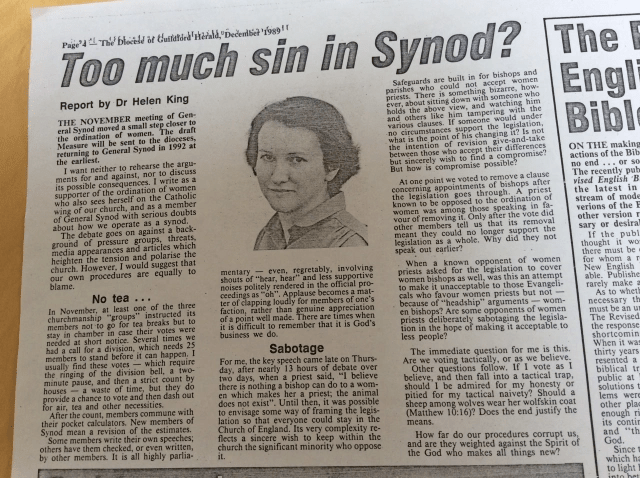
To mark the 30th anniversary, and as we move towards another potentially difficult debate in February 2023 on Living in Love and Faith, I am copying below the full text of a piece I wrote back in December 1989, after an earlier November Synod which dealt with just one step along the winding road which led to the vote in November 1992. I hope it’s a reminder of how long it took, the stages it went through, and the unpleasantness of the process. Neither the title nor the subheadings were mine. The questions with which I ended are ones with which I still grapple now that I am back on Synod after nearly 30 years away from it. So… here goes.

Diocese of Guildford Herald, December 1989: TOO MUCH SIN IN SYNOD?

The November meeting of General Synod moved a small step closer to the ordination of women. The draft Measure will be sent to the dioceses, returning to General Synod in 1992 at the earliest.

I want neither to rehearse the arguments for and against, nor to discuss its possible consequences. I write as a supporter of the ordination of women who also sees herself on the Catholic wing of our church, and as a member of General Synod with serious doubts about how we operate as a synod.

The debate goes on against a background of pressure groups, threats, media appearances and articles which heighten the tension and polarise the church. However, I would suggest that our own procedures are equally to blame.

No tea…

In November, at least one of the three churchmanship ‘groups’ instructed its members not to go for tea breaks but to stay in chamber in case their votes were needed at short notice. Several times we had a call for a division, which needs 25 members to stand before it can happen. I usually find these votes – which require the ringing of the division bell, a two-minute pause, and then a strict count by houses – a waste of time, but they do provide a chance to vote and then dash out for air, tea and other necessities.

After the count, members commune with their pocket calculators. New members of Synod mean a revision of the estimates.

Some members write their own speeches; others have them checked, or even written, by other members. It is all highly parliamentary – even, regrettably, involving shouts of ‘hear, hear’ and less supportive noises politely rendered in the official proceedings as ‘oh’. Applause becomes a matter of clapping loudly for members of one’s own faction, rather than genuine appreciation of a point well made. There are times when it is difficult to remember that it is God’s business we do.

Sabotage

For me, the key speech came late on Thursday, after nearly 13 hours of debate over two days, when a priest said, ‘I believe there is nothing a bishop can do to a woman that makes her a priest; the animal does not exist’. Until then, it was possible to envisage some way of framing the legislation so that everyone could stay in the Church of England. Its very complexity reflects a sincere wish to keep within the church the significant minority who oppose it.

Safeguards are built in for bishops and priests who could not accept women priests. There is something bizarre, however, about sitting down with someone who holds the above view, and watching him and others like him tampering with the various clauses. If someone would under no circumstances support the legislation, what is the point of his changing it? Is not the intention of revision give-and-take between those who accept their differences but sincerely wish to find a compromise? But how is compromise possible?

At one point we voted to remove a clause concerning appointments of bishops after the legislation goes through. A priest known to be opposed to the ordination of women was among those speaking in favour of removing it. Only after the vote did other members tell us that its removal meant that they could no longer support the legislation as a whole. Why did they not speak out earlier?

When a known opponent of women priests asked for the legislation to cover women bishops as well, was this an attempt to make it unacceptable to those Evangelicals who favour women priests but not – because of ‘headship’ arguments – women bishops? Are some opponents of women priests deliberately sabotaging the legislation in the hope of making it acceptable to less people?

The immediate question for me is this. Are we voting tactically, or as we believe.

Other questions follow. If I vote as I believe, and then fall into a tactical trap, should I be admired for my honesty or pitied for my tactical naivety? Should a sheep among wolves wear her wolfskin coat (Matthew 10:16)? Does the end justify the means.

How far do our procedures corrupt us, and are they weighted against the Spirit of the God who makes all things new?

Posted in Church of England and gender, General Synod | Tagged , , | Leave a comment

Living in Love and Faith: some thoughts on the Church Society’s report

This week General Synod members received a report sent to them from the Church Society, taking issue with the most recent documents from LLF

It was only a matter of time. It has been obvious, since the point at which the LLF process included a course survey, that the questionnaires and other responses from those who did that course were not going to be simple to interpret. Obvious, not just because not all of those who decided to ‘take the course’ would bother with the questionnaire, but also because that questionnaire was explicitly not asking about what participants thought should happen next, concentrating instead on how they found the course itself. The analysis of the data was never going to come up with ‘the mind of the Church of England’; so, to the Church Society’s (rhetorical) question, “are we really supposed to carry out doctrinal change by SurveyMonkey?”, I’d reply, “Obviously not and that was never the intention”. 

Initially, I wasn’t particularly impressed by the questionnaire and explained why here. But I’ve now read the official analysis of the responses (Listening with Love and Faith) and I think that the researchers (whose professionalism is wrongly questioned by the Church Society) have used the material from respondents as well as they could have done. They’ve produced an accurate impression of the range of views currently being expressed, and given a clear overall picture of a church in which people agree that the current situation needs to change. 

In this piece, I am going to continue giving direct quotations from the Church Society document in italics, grouping together some points made more than once, and then I’ll respond to them in turn. I’m not going to address the very small numbers filling in the questionnaire or taking part in focus groups; those doing the official analysis have already made clear that they are reflecting the range of views out there rather than trying to make numerical points. Using their experience of questionnaires and response rates, they have made a case for those apparently small numbers of submissions turning out to be a good result.

First, the Church Society challenges whether those who responded represent ‘real’ Church of England people. “There were no questions concerning church attendance or faith so it is not possible to measure what percentage of respondents attend the Church of England (or any other church) or identify as Christians. This makes it difficult to gauge to what extent this represents the view of the Church of England” and, from the conclusions, “There was no attempt to ensure that respondents were members of the Church of England.” Since we don’t have “members’, that is an odd comment, and furthermore the intention of the survey was never to discover ‘the’ view of the Church of England. As it’s a C of E course, and as you were asked to name your diocese when you filled in the questionnaire, it seems likely that respondents identified as C of E. Maybe some Local Ecumenical Partnerships did the course too? Or someone turned up with a spouse who goes to another church? I suspect the Church Society doesn’t know the answer to these questions either.

Second, while attacking the results as unrepresentative, the Church Society seems to conflate the Church of England with England; and church attenders, with the wider population. For example, “Respondents were older than the national average as can be seen from the chart above. 83.3% of the respondents were over 45 as opposed to 53.5% of the population as a whole. 40.4% of those responding were 65 or older and only 1.6% were under 25 (around 100 people).”  

And “if you live amongst the most affluent 10% of England you were over seven times more likely to take part in the survey than if you live amongst the poorest 10%. This really should give the Church of England pause: why are we mainly listening to the well off? Why were there no black or Asian participants in the Focus Groups?”

“poorer and non-white voices were not heard”

“Amongst the respondents there was a bias towards more affluent people”. 

Yet this was never intended to be an analysis of the views of the nation, so it isn’t relevant to compare the respondents with the “population as a whole”. Rather, the survey is aimed at producing a reflection of the different views held in the Church of England, and those demographics sound very much like they really are representative of the Church of England: largely white, largely middle-class, pretty old. The Church Society analysis actually goes on to admit this:“This, of course, reflects the reality that congregations in the Church of England are older than the national average.” And whiter, and more affluent…

Similar points are made about people’s level of comfort with text and with discussion groups, and about issues with access to IT:

“Arguably the nature of the resources and the course itself privileged those who were comfortable with long text-based documents and discussion groups. Moreover, to engage with the online resources, online focus groups and the survey itself required good IT access.”

Again, yes, to some extent. But, on being comfortable with text, the LLF process fully acknowledged that the materials are ‘wordy’ and I guess that’s precisely why that process encouraged artistic and creative responses. Mind you, from the selection of these responses displayed at the York General Synod some of them demonstrate access to facilities and materials which may be further out of reach for some people. The member of General Synod who circulated the Church Society report, Ros Clarke, associate director of the Church Society, is herself an accomplished crafter, whose kneeler with the words “Christ is better than sex” was featured in the official LLF analysis of responses (p.63); the pattern is published here. So she’s well aware that text wasn’t the only way of responding.

And then – since this is LLF we’re talking about – there’s sex. I have been trying to make sense of the figures being used for the proportion of the population who would call themselves ‘heterosexual’, but I’m not doing well on this. Both the LLF report and the Church Society report reference the government figures for 2020, which state that “The proportion of the UK population aged 16 years and over identifying as heterosexual or straight was 93.6% in 2020”. Yet at one point the Church Society has “Nationally, 96.1% of the population self-identifies as heterosexual and yet 89.4% of whose who took part in the survey so identify” and at another offers “it is clear that the respondents to LLF differ greatly from the population as a whole. Nationally 96.1% of those who identified their sexuality were heterosexual, as opposed to 84.5% of those who did so in the LLF survey. This either suggests that 15% of the church is LGBTQ+, almost four times the national average, or that LGBTQ+ people were more likely to participate in the survey than non-LGBTQ+ people. Given the importance of this process, and the understandable desire for those who feel strongly about this matter to have their voice heard, the latter is more likely.”

Whatever figures we are using, the message the Church Society wants to give seems to be that the questionnaire was filled in by an inordinate number of people who aren’t straight: “Amongst the respondents there was a bias towards more affluent people with a very high representation of those identifying as LGBTQ+.” So not just gay people, but well-off gay people? “This especial attention to the voices of the LGBTQ+ community echoes the high level of LGBTQ+ engagement in the online survey”.

I don’t find the figures “very high” and I don’t think they’re at all surprising. As for that “especial attention”, as the comments made by participants are not attributed in the ‘Gay middle-aged man from a northern diocese” style, but are entirely unattributed, how can the reader of the LLF reports know whether they are hearing an LGBTQ+ voice or a straight married person’s voice? Simple answer: they can’t. And, goodness, all these gay people who “feel strongly about this matter”… well, people with all sorts of views ‘feel strongly’, but for those who can’t marry in their church or whose vocations are not accepted because they have married someone of the same sex it’s about rather more than ‘feelings’. 

If you really want to know how people responded to the course, I suggest going back to the original reports on the LLF site; you’ll find a richer, more interesting and more accurate picture of people’s experiences there.

update, 26 October: the LLF team have now published the responses from the organisations who carried out the analysis of the questionnaires, and they are well worth reading. You can see those from both Brendan Research and Church Army’s Research Unit here: LLF Response to Church Society Analysis.

Posted in Episcopal Teaching Document, General Synod, Living in Love and Faith | Tagged , , , | 3 Comments