
Credit: Wellcome Library, London
It’s funny, isn’t it, how all the Church of England statements seem to assume that we know what we mean when we talk about sex in the sense of people doing things with each other? Sex in the other sense – the ‘what sex are you?’ sense – is something else and I may come to the biology of that in another blog post.
The February 2014 ‘Statement of Pastoral Guidance on Same Sex Marriage’ issued by the House of Bishops stated that ‘marriage’ can only be between two people of different sexes. Yet it reaffirmed the view that ‘living faithfully in covenanted same sex relationships’ is A Good Thing and can ‘embody crucial social virtues’ including ‘genuine mutuality and fidelity’. That needs to be read alongside the current Church of England distinction between orientation – being attracted to those of the same sex – and practice – being sexually active with someone of the same sex. This is particularly important for clergy who, at least officially, can be ‘same-sex attracted’ but not be ‘same-sex active’. Although, when it comes to Jeffrey John, the Dean of St Albans, who’s gay and has been in a relationship with his civil partner since 1976 but says he’s living a celibate life, when you look at the various sees to which he still hasn’t been appointed as bishop, it seems like all that really matters is orientation.
In that ‘embody crucial social virtues’ phrase, the word ‘embody’ is interesting because it’s precisely the body side of things which is the problem. ‘Sexually active’ has always struck me as a very odd phrase too. It sounds like it’s OK if you’re lying back and thinking of England, but not if you’re moving around. But putting that thought aside, what counts as ‘sex’ here?
The way that the various official statements from the Church of England talk about it, it’s assumed we all know, and furthermore that we know what sex is regardless of whether someone’s gay or straight. Indeed, on those very few occasions when I’ve asked the question in church circles, the normal response I get is on the lines of ‘Don’t be so silly, we all know perfectly well what we’re talking about here’. Well, sorry, I still don’t. For a start, what about masturbation, famously defined by Woody Allen as ‘sex with someone you love’?
One of the key documents in all this is the 1991 House of Bishops’ Statement, ‘Issues in Human Sexuality’. [When I wrote this blog post, only Chapter 5 was conveniently available in full, online, but as of Dec 2021, so is the whole document.] There’s also a 44-page Study Guide. The relevant parts were summed up very well on a post which used to be on the ‘Changing Attitude’ site:
‘Paragraph 5.17, p45 of Issues, says: “We have, therefore, to say that in our considered judgement the clergy cannot claim the liberty to enter into sexually active homophile relationships” … The bishops also felt confident in writing in paragraph 5.11 on p43 that: “We believe that the great majority of [lesbian and gay] clergy are not in sexually active partnerships.” The bishops had no empirical evidence for making that statement in 1991. They have no empirical evidence now, but many bishops, in private, know some of their partnered lesbian and gay clergy, and affirm their relationships’.
Again, lots of forbidden ‘activity’.
Another central document is the 2005 House of Bishops’ pastoral statement on civil partnerships which includes the line:
‘Sexual intercourse, as an expression of faithful intimacy, properly belongs within marriage exclusively’.
That seems very outdated indeed, when no less an Anglican than the Archbishop of York did not condemn Prince William for living with Kate Middleton before they married. In 2011 government figures show that 78% of couples marrying in a religious ceremony lived together first. I suppose some of them are just sharing a flat and not a bed, which is entirely their own business – but not all of them.
So does ‘sexually active’ somehow equate to ‘sexual intercourse’, ‘full penetrative sex‘? In which case, mutual masturbation wouldn’t count as ‘sex’. And what’s ‘intercourse’? Because if we mean ‘penis in vagina’ – which, if we’re going to argue that ‘proper sex’ has to be between a man and a woman with some theoretical chance of producing a pregnancy, may seem a logical starting point – then what happens if there’s no penis or no vagina in the bed? Maybe what is meant is penetration – but, just thinking about men here, ‘the idea that all gay men enjoy anal intercourse is a myth’.
A 2008 article, ‘Going most of the way: “technical virginity” among American adolescents’, challenged the view that ‘sexual substitution’ – having oral or anal sex but not vaginal sex, in order to ‘stay pure’ or ‘save oneself for marriage’ – is any more common among heterosexual Christians than among other groups in the USA. But it’s one option. Is that OK with the Bishops? Is it intercourse? And the authors pointed out that the definition of ‘sex’ remains confused for people who aren’t bishops, too; in a 1999 study it was found that ‘only 40 percent of college students consider oral sex to be “sex”’. And of course Bill Clinton ‘did not have sexual relations with that woman’.
So I’m genuinely unclear what it is that people – gay or straight – are and aren’t allowed to do under the various Bishops’ statements. I don’t think the answer is to issue a list of activities – as in the medieval penitentials, for which a superb flow chart has been constructed – and even the thought of such a list shows just how silly the whole distinction between orientation and practice really is.
As an antidote to the Bishops’ implied interest in what we all do in our bedrooms – or elsewhere – I’d commend to everyone the 2013 Pilling Report, which led to the Shared Conversations process. It includes Jessica Martin’s shimmeringly beautiful, profound and prophetic introductory essay on the idolization of desire, which somehow cuts through all the episcopal circumlocutions and pettiness of attempts to categorise and condemn pleasure.
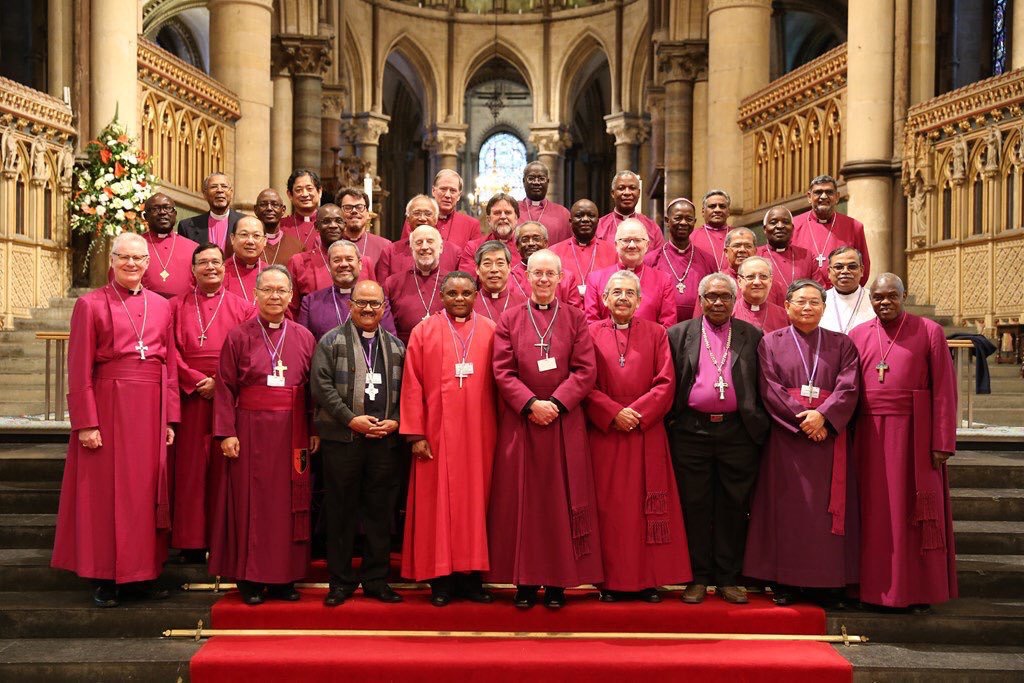 It’s been a strange week, waiting to see whether the GAFCON churches would walk out of the Primates’ meeting, listening to the media herald this as the end of the Anglican Communion, wondering what a world without the Anglican Communion would look like… Social media seemed like the best way to keep in touch with what was going on, so I duly followed #Primates2016 but, as is so often the case,