A Betjeman moment

I was encouraged today, at the end of the Week of Prayer for Christian Unity, to have drawn to my attention John Betjeman’s Septuagesima, which includes:


So other Churches please forgive
Lines on the Church in which I live,
The Church of England of my birth,
The kindest Church to me on earth.
There may be those who like things fully
Argued out, and call you “woolly”;
Ignoring Creeds and Catechism
They say the C. of E.’s “in schism”.

Lines in praise of woolliness… They echoed this morning’s sermon, in which the preacher pointed out that we manage to stay together despite our different views of, and activities associated with, earlier controversial issues like the remarriage of divorced people and the ordination of women, and he ended with the image of the Second Coming and Christ asking what we’re up to at the moment: ‘What are going to say? “Lord, we are confused: should we split? Because we can’t agree on sexuality.” “Pardon? What are you talking about?”‘

I don’t think I’m doing a very good job of summarizing here, but I hope the point comes across. Why is it this issue, not marriage after divorce or the ordination of women, which is presented as the Crunch Issue? Why can’t we apply a bit of Anglican woolliness to it and accept that we don’t agree, and get on with doing the work of Christ in the world? Again, what do we prioritize: truth or unity? In terms of the first issue, marriage after divorce, I just get on with it, although if my husband was testing his call to ordained ministry and came up against an objection to him offering himself because he’s been married before, then maybe I wouldn’t feel so relaxed. I probably need to go back to read the debates on this older issue (which now feels like a non-issue) to remind myself of how it played out at the time… Back to Google!


Posted in Uncategorized | Tagged , , , , , | Leave a comment

What is sex anyway?

Credit: Wellcome Library, London

Credit: Wellcome Library, London

It’s funny, isn’t it, how all the Church of England statements seem to assume that we know what we mean when we talk about sex in the sense of people doing things with each other? Sex in the other sense – the ‘what sex are you?’ sense – is something else and I may come to the biology of that in another blog post.

The February 2014 ‘Statement of Pastoral Guidance on Same Sex Marriage’ issued by the House of Bishops stated that ‘marriage’ can only be between two people of different sexes. Yet it reaffirmed the view that ‘living faithfully in covenanted same sex relationships’ is A Good Thing and can ‘embody crucial social virtues’ including ‘genuine mutuality and fidelity’. That needs to be read alongside the current Church of England distinction between orientation – being attracted to those of the same sex – and practice – being sexually active with someone of the same sex. This is particularly important for clergy who, at least officially, can be ‘same-sex attracted’ but not be ‘same-sex active’. Although, when it comes to Jeffrey John, the Dean of St Albans, who’s gay and has been in a relationship with his civil partner since 1976 but says he’s living a celibate life, when you look at the various sees to which he still hasn’t been appointed as bishop, it seems like all that really matters is orientation.

In that ‘embody crucial social virtues’ phrase, the word ‘embody’ is interesting because it’s precisely the body side of things which is the problem. ‘Sexually active’ has always struck me as a very odd phrase too. It sounds like it’s OK if you’re lying back and thinking of England, but not if you’re moving around. But putting that thought aside, what counts as ‘sex’ here?

The way that the various official statements from the Church of England talk about it, it’s assumed we all know, and furthermore that we know what sex is regardless of whether someone’s gay or straight. Indeed, on those very few occasions when I’ve asked the question in church circles, the normal response I get is on the lines of ‘Don’t be so silly, we all know perfectly well what we’re talking about here’. Well, sorry, I still don’t. For a start, what about masturbation, famously defined by Woody Allen as ‘sex with someone you love’?

One of the key documents in all this is the 1991 House of Bishops’ Statement, ‘Issues in Human Sexuality’. [When I wrote this blog post, only Chapter 5 was conveniently available in full, online, but as of Dec 2021, so is the whole document.] There’s also a 44-page Study Guide. The relevant parts were summed up very well on a post which used to be on the ‘Changing Attitude’ site:

‘Paragraph 5.17, p45 of Issues, says: “We have, therefore, to say that in our considered judgement the clergy cannot claim the liberty to enter into sexually active homophile relationships” … The bishops also felt confident in writing in paragraph 5.11 on p43 that: “We believe that the great majority of [lesbian and gay] clergy are not in sexually active partnerships.” The bishops had no empirical evidence for making that statement in 1991. They have no empirical evidence now, but many bishops, in private, know some of their partnered lesbian and gay clergy, and affirm their relationships’.

Again, lots of forbidden ‘activity’.

Another central document is the 2005 House of Bishops’ pastoral statement on civil partnerships which includes the line:
‘Sexual intercourse, as an expression of faithful intimacy, properly belongs within marriage exclusively’.
That seems very outdated indeed, when no less an Anglican than the Archbishop of York did not condemn Prince William for living with Kate Middleton before they married. In 2011 government figures show that 78% of couples marrying in a religious ceremony lived together first. I suppose some of them are just sharing a flat and not a bed, which is entirely their own business – but not all of them.

So does ‘sexually active’ somehow equate to ‘sexual intercourse’, ‘full penetrative sex‘? In which case, mutual masturbation wouldn’t count as ‘sex’. And what’s ‘intercourse’? Because if we mean ‘penis in vagina’ – which, if we’re going to argue that ‘proper sex’ has to be between a man and a woman with some theoretical chance of producing a pregnancy, may seem a logical starting point – then what happens if there’s no penis or no vagina in the bed? Maybe what is meant is penetration – but, just thinking about men here, ‘the idea that all gay men enjoy anal intercourse is a myth’.

A 2008 article, ‘Going most of the way: “technical virginity” among American adolescents’, challenged the view that ‘sexual substitution’ – having oral or anal sex but not vaginal sex, in order to ‘stay pure’ or ‘save oneself for marriage’ – is any more common among heterosexual Christians than among other groups in the USA. But it’s one option. Is that OK with the Bishops? Is it intercourse? And the authors pointed out that the definition of ‘sex’ remains confused for people who aren’t bishops, too; in a 1999 study it was found that ‘only 40 percent of college students consider oral sex to be “sex”’. And of course Bill Clinton ‘did not have sexual relations with that woman’.

So I’m genuinely unclear what it is that people – gay or straight – are and aren’t allowed to do under the various Bishops’ statements. I don’t think the answer is to issue a list of activities – as in the medieval penitentials, for which a superb flow chart has been constructed – and even the thought of such a list shows just how silly the whole distinction between orientation and practice really is.

As an antidote to the Bishops’ implied interest in what we all do in our bedrooms – or elsewhere – I’d commend to everyone the 2013 Pilling Report, which led to the Shared Conversations process. It includes Jessica Martin’s shimmeringly beautiful, profound and prophetic introductory essay on the idolization of desire, which somehow cuts through all the episcopal circumlocutions and pettiness of attempts to categorise and condemn pleasure.

Posted in Uncategorized | Tagged , , , , , , , , , , , , | 10 Comments

A tale of two Primates

Source: A tale of two Primates

Posted in Uncategorized | Leave a comment

Waiting for GAFCON

IMG_0797It’s been a strange week, waiting to see whether the GAFCON churches would walk out of the Primates’ meeting, listening to the media herald this as the end of the Anglican Communion, wondering what a world without the Anglican Communion would look like… Social media seemed like the best way to keep in touch with what was going on, so I duly followed #Primates2016 but, as is so often the case, Thinking Anglicans was by far the best way to check on actual events as well as their representation in the media. In the end, only one Bishop walked out, but the statement that was issued by the primates is still being studied for its nuances.

At the beginning of the week, what was reported as the Archbishop of Canterbury’s speech was clearly making a gesture towards the African churches in the comment that ‘for me it was indigenous Kenyan and Ugandan faith, through the Revival’s legacy, that brought me salvation’. Whether this raised the GAFCON churches’ hopes of the ‘repentance’ they were asking for from the Episcopal Church, for having ordained openly gay people and allowing same-sex marriage – or came across as a sop offered before ignoring their call – I don’t know.

And at the end of the week, where are we? GAFCON didn’t get the repentance they asked for. The Episcopal Church are on the naughty step for three years, with their Presiding Bishop Michael Curry producing a moving and articulate statement of the TEC’s way of inclusion as not some capitulation to American culture but the result of a process of engaging with the Bible every bit as valid as the approach taken by their opponents. There’s the usual talk about ‘hurt’, although the Archbishop of Canterbury doesn’t seem to get it at all. Feeling offended is one thing (we’ve all been there) but if you’re a LGBTI Christian in an African country where your sexuality is criminalised and you can be murdered for it then it’s rather more than ‘hurt’. Why doesn’t the Anglican Communion do more to speak out against these atrocities? The Archbishop of Canterbury has been pulled up already for talking about the hurt to the LGBTI community as if this is a clear entity, and I’d add here that you don’t have to be LGBTI to feel the hurt of these political manoeuvres to feed the GAFCON hunger for repentance. It was always a one-way street: the liberals called to repent of their disregard for something allegedly so clearly laid down in the Bible, but never the traditionalists called to repent of not having thought that the Spirit could move us to full acceptance of same-sex attracted and other Christians who want to live their lives to the full in a way that mirrors God’s abundant and faithful love for all.

So, once again, as the Shared Conversations process so clearly acknowledges, it’s all about how we see the Bible. Traditionalists come across like they have a monopoly on it. But, for the record, I don’t believe any sentence starting ‘The Bible says that…’ is doing justice to the Bible. The Bible isn’t simple and it doesn’t all work at one level. There are poems and chronicles and songs and letters. They come from centuries of cultural change. We’ve always known this and acted on it: most of us don’t treat Deuteronomy or Leviticus on not wearing garments made of mixed fabrics as valid for today. If we treat the Bible as if it’s a list of do/don’t or as a sort of human car manual, we miss out the bigger story: the overall shape of the Bible that tells us about God. It’s like using an iPad as a chopping board – not only does it fail to understand the richness of the thing, it’s also not very effective.

The statement issued at the end of the week includes: ‘In keeping with the consistent position of previous Primates’ meetings such unilateral actions on a matter of doctrine without Catholic unity is considered by many of us as a departure from the mutual accountability and interdependence implied through being in relationship with each other in the Anglican Communion.’ I appreciate that ‘considered by many of us’: it allows for different views to exist. But what would a Catholic unity look like here? How would it ever be reached?

To me, there are echoes again here of the arguments that surrounded the ordination of women. In 1974 the ‘Philadelphia 11’ were ordained priest, and TEC first regarded this as irregular and invalid. A male priest protesting at the service said ‘God here now as father and judge sees you trying to make stones into bread’. In 1976 TEC’s judgement was changed to irregular but valid. At that time in the Church of England we were told not to rock the ecumenical boat; we must hold back from action because it would end our dialogue with other churches (conveniently, there was less said about how a decision to ordain women would encourage our dialogue with other churches!). I remember someone making the point that, if we were going to maintain dialogue with the Coptic Church, we’d need to stop menstruating women receiving the sacrament of Holy Communion. Sometimes, the search for unity shouldn’t be the main driver of our actions. But now we have women as priests, and as bishops. Why is our decision as a province to permit these things any different from the TEC’s decision to ordain openly gay people?

So would a walkout have been better? One of our local bishops, Bishop Alan, wrote at the beginning of this eventful week about the value of staying in the same room:

I once had a phone call, as a Bishop, from someone who had walked out of a church council meeting in high dudgeon, and they’d forgotten that they were actually in their own house. So they found themselves in their front garden at 11 o’clock at night without a key to get back in again. So they phoned the Bishop… I feel rather sorry for that person. When you’ve walked out, what you do next? What are you walking into? Wouldn’t it be better to stay and talk? Jesus brings together heaven and earth — everything reconciled in him, says Paul. Don’t you think we could try that way instead of all the showboating politics and stuff that goes on in the world? I’d like to feel that we could, and I hope and pray that we can this week.

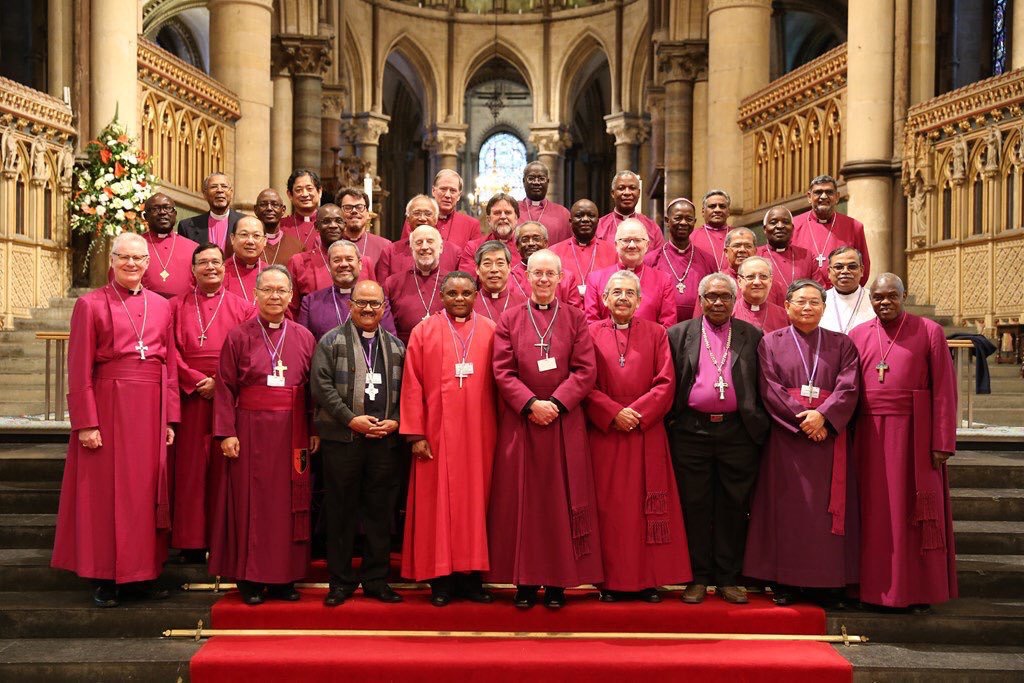
I’m no longer so sure. How do we stay in the room when every instinct is telling us to leave? Hopefully the Shared Conversations, being led by properly trained facilitators, won’t make me want to run away. Meanwhile, just take another look at the official picture of the primates at the top of this post. Racially, considerably more diverse than many of our congregations. But all men, and probably all straight. Do they really understand what they’re talking about here?


Posted in Church of England and gender | Tagged , , , , , , , , , , | Leave a comment

Putting ourselves into boxes

I’ve been looking at some more of the reflections posted by those who’ve already taken part in other dioceses’ Shared Conversations. The website of Evangelical Group of the General Synod (EGGS) has several of these, of which one is anonymous but by someone ‘aged under 35’. S/he describes her/himself as ‘an orthodox Reformed Evangelical Christian’. S/he ‘had been dreading’ the SC weekend and turned up ‘with a heavy heart’ (raising the question, so if it was so upsetting, why did you agree to go?). S/he was disturbed by being in a minority among a largely ‘liberal’ gathering: ‘the orthodox evangelical side was outnumbered four to one’. Indeed, as a result of all this non-orthodox presence, s/he comments ‘I have never heard so much brazen and dangerous heresy in one place’.

I’m sure a lot of people would empathise with that feeling of being in a minority (although I think I’ve been in more slender minorities than this) but … side?? Heresy? If I’m understanding just one thing about the SCs, it’s that in the atmosphere of being listened to that they aim to create, there aren’t any sides. And the H-word is one I’d be very cautious about aiming at those with whose views I disagree. Having said that, one of the few times I’ve used it was when listening to the penultimate General Synod debate (November 2012) on women bishops, when a speaker talked about how in the Trinity the Son is eternally subordinate to the Father – now that one I do think counts as heresy. If I’ve got my church history right, the Arian heresy – the first church controversy to be decided by an ecumenical council – is the one that denied the equality of Father and Son.

EGGS’s anonymous blogger, I suspect using the age label rather than any other possible tag (race? gender? occupation? From a couple of comments made, the writer seems to be ordained) in order to show that it’s not just older people who hold these views, clearly had a bad experience, not least when the other two people in the triplet to which s/he was assigned tried to argue her/him round to their views. That sounds horrendous, and it’s clearly not the sort of listening the SCs are intended to model. However, as s/he writes earlier about ‘my citing passages such as …’, the impression given is of someone turning up with a set of Bible verses used as what are often called ‘clobber texts‘ – it doesn’t look like it was only the the liberals who were out to argue rather than to listen with respect.

One question this raises for me is that of the label ‘an orthodox Reformed Evangelical Christian’. What does this mean? Why the capitalisation? Is there such a thing as a non-orthodox R.E.C.? How would l label myself? What would an un-Reformed Evangelical Christian believe?

I think the only time I’ve used any faith label seriously  was in my early twenties, when I belonged to the Church Union [note to non-Christians: this wasn’t and isn’t a union in the ‘trades union’ sense!] and would have described myself as Anglo-Catholic. I was keen to see the Church of England as the Catholic Church of this land, with the bonus of having been through the Reformation too. After I had my Road to Damascus moment of switching from being entirely opposed to the idea of women priests – because I believed that priests needed to be men in order to stand for Jesus at the altar – I stopped using that label. The moment came in a Deanery Synod meeting when the wonderful theologian Mary Tanner was going through and respectfully demolishing the various objections to women as priests, from all directions. She  pointed out that priests didn’t have to be Jewish, or the same age as Jesus when he died, so why did they have to be of the male sex? What they were ‘representing’ at the altar was humanity, Jesus as God-With-Us, not one aspect of the particularity of his humanity. Oops, I thought. She’s right. So I went home and filled in my membership form for the Movement for the Ordination of Women, sent it off the next morning, and never looked back.

Would I label myself now? Probably not beyond ‘Church of England’. If pushed, ‘liberal’, although I don’t like it because I’m probably more liberal on some issues than on others.

The label ‘orthodox Reformed Evangelical Christian’ also reminds me of a joke I’ve used when leading Emmaus groups; it won the category ‘funniest religious joke‘ on the Ship of Fools website in 2005. It’s about a man who is trying to talk a potential suicide out of jumping off a bridge, and is getting on well at persuading him there’s so much to live for, and finding that not only are they both Christians, but they are both Baptists, until it all goes wrong:

“Are you Reformed Baptist Church of God, Reformation of 1879, or Reformed Baptist Church of God, Reformation of 1915?”

He said: “Reformed Baptist Church of God, Reformation of 1915.”

I said: “Die, heretic scum,” and pushed him off.

I appreciate why we claim labels. We want to make sure people know where we’re coming from. We want to make connections with like-minded people. But we are often far more complicated than any label can capture. And – dare I say it? – our views may change. Labels fail to do justice to our complexity, and they stop us seeing each other as people.

Posted in Shared Conversations | Tagged , , , , , , , , , , , , , , , , | 3 Comments

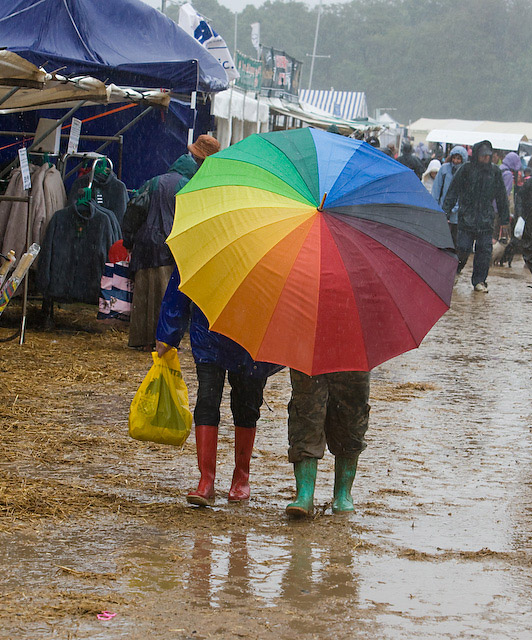
Under the umbrella: living with difference

Main Avenue South

Main Avenue South

Peter Facey: Washout at the New Forest Show 2007
© Copyright Peter Facey and licensed for reuse under this Creative Commons Licence.

One of the questions raised by the Church of England’s current disagreements on sexuality concerns how far it’s even possible to claim we’re one church when we hold such different opinions. It seems to be OK to keep together those with massive differences in ‘practice’; for example, to include under the umbrella churches who won’t use even the wide range of services in the Common Worship book, whether that means using Roman Catholic services or making them up from scratch. As an enthusiastic teenager I remember dragging my long-suffering father along to the next parish church along from ours, after finding out (via being one of the youngest members of Deanery Synod) that they were Anglo-Catholic and wondering what that meant. He went through the whole service under the impression that it was in Latin – in fact the priest just spoke very quickly – but the point is that he wouldn’t have been entirely surprised to find Latin being used in the C of E. After all, in everything other than language – the wording of the service, the vestments, the gestures – it was entirely unlike anything with which we were familiar. That church now defines itself as ‘modern Catholic’. Later on, I had a spell of regular attendance at All Saints, Margaret Street, where I experienced a form of Anglo-Catholicism which I found very much to my taste. Indeed, one of the most intense moments of religious experience I’ve had in my life happened there. The other happened in an evangelical church that was pretty well ignoring the fact that it was in the C of E. Both churches, I’ve just realised, were equally ‘gathered’ churches – bringing together people from a wider geographical area than the parish, that building block of the C of E. By definition, then, they held like-minded people – unlike your average parish church which brings together people with more diverse beliefs and opinions.

At the moment, the two areas where it’s difficult to ignore our differences and to keep everyone under the umbrella are gender and sexuality. Here’s a comment from a recently-published piece on women and leadership in the church. What is the message a woman hears from the C of E?

She hears that women can lead but she sees male leaders. She hears that she should marry and that her ideal leadership role is ministry alongside an ordained husband. She hears that she should not lead and that she is not capable of leading. She hears that she should lead, and as a woman she has a special contribution to make to the Church. She hears that she is created in the image of God, to live life in fullness and freedom and to use and develop her gifts as she becomes the person she was created to be.

It is hardly surprising if she is a little confused.

And then there’s sexuality.

The long reluctance of the churches to face the way in which some in authority have abused that authority remains an abomination. It’s been quite a week for that, as another survivor has gone public about her sexual abuse by a member of the clergy here. Yet in the very same week another member of the clergy has been prevented from taking services because he’s married his partner of thirty years. So, in one case a priest used his position of trust to abuse a young woman. In another, a priest affirms his loving relationship with another man in an entirely legal ceremony. But the first is covered up and attempts are made to preserve that priest’s ministry (scarily, he is now a minister in a non-Anglican church): and the second leads to curtailing the priest’s ministry.

Professor Julie Macfarlane, writing about her sexual abuse, concluded:
But my higher goal here is to expose the chasm between the public statements of the Church and their complicity in this immoral approach to sex-abuse litigation.
A different sort of chasm exists with same-sex relationships. Here’s one public document:
the 2014 statement from the House of Bishops included the wording that
We are conscious that within both Church and society there are men and women seeking to live faithfully in covenanted same sex relationships.
But being conscious of something doesn’t mean approving of it. The public statement isn’t an affirmation of such men and women, but we are all in agreement that the Christian understanding and doctrine of marriage as a lifelong union between one man and one woman remains unchanged.

So, we know that men and women are living like this, but we’re not going to call it marriage, because for that one person has to be a man and the other a woman. Yet we’re also finally realising that not everyone fits easily into the man/woman binary. Bodies are complicated. You may have the right organs to count as a man, but what if they don’t work? You may look like a woman but be born without a womb. Your body may not match how you feel about yourself. Who polices bodies to decide where they fit? The model Rain Dove is the most public face of those who call themselves ‘genderqueer’, whose bodies don’t fit into neat categories. I want to listen to voices that come from outside the binary. I find the voices of the public statements of the Church less and less reassuring. Maybe the umbrella will never be big enough to fit us all under it – and maybe there are some situations in which I’d rather get wet than be complicit with those who are holding it over me.

Posted in Shared Conversations | Tagged , , , | 2 Comments

Good disagreement?

So I’ve been thinking about the goal of the Shared Conversations process, ‘good disagreement’. This has meant some reflecting around the theme of conflict management, and I’ve been following up some references to ‘integrative complexity’.

If you have a low IC score, that indicates that you’re thinking in very polarized terms – ‘I’m right, they’re wrong’ or ‘I’m good, she’s bad’. Indicators of low IC scores are found when you analyse speeches made shortly before conflict breaks out; shades of grey disappear at that point (a discovery that feels very close to home, with the Syria vote in Parliament tomorrow). Higher IC scores indicate that the speaker is doing better at finding some common ground, not giving up their core beliefs but instead understanding that there may be something that they and the Other share. This sounds a lot like the goal of ‘good disagreement’.

An example. Some hours before I preached at Evensong the Sunday before last, I met a friend who is a regular at that service who wanted to know what I’d be preaching about. It being the feast of Christ the King, I said ‘Christ the King’. That wasn’t what she needed to know. The question, as she rephrased it, was something like ‘Will Jesus be glorified in your sermon?’ I found this very difficult to answer. Part of that is the problem of ‘Christianese’. We all use different language to talk about God-stuff. The phrasing she used isn’t in my vocabulary, which is why I’m not even sure I have it right here (the only witness says he thinks I have) and there are plenty of things I say that probably sound alien or indeed risky to her. So, I answered in a generally affirmative way (because, of course, I’d be exploring Jesus’ kingship and what sort of king he is) and tried to add in something about how what the preacher says isn’t necessarily what the congregation hears; I’m sure everyone who preaches can come up with occasions on which a listener has said ‘thank you for that, I found what you said about Topic A really helpful’ and you think, er, that wasn’t what I was talking about… But that’s all fine because a sermon isn’t a lecture.

However, this was only the beginning. It turned out she had been very disturbed by a sermon I’d preached in August, in which I’d started from the Archbishop of York telling the lay reader Jeremy Timm to choose between marrying his male partner or continuing in his role as a reader. I was shocked by what had happened there – the extension of the existing ‘one rule for clergy, another for laity’ to the laity; the disparity between what different dioceses do; and don’t get me started on either of those! And, as a lay preacher, who happens to be a woman married to a man, I feel for other lay ministers who find a life partner who is of the same sex, are now legally allowed to marry that partner, but then can’t serve the church (if they happen to be in York, at least).

One of the readings that Sunday was from Hebrews 13. On immersing myself in the readings, what stood out for me as the overall message was the primacy of love, so I found I was reading the Bible through the lens of what had just happened in York diocese. I drew on my knowledge of New Testament Greek to explore some of the terms for sexual relationships in the Hebrews passage. I tried to contextualize the Bible and point out something of the way that any translation is also an interpretation – so, for example, the term for marriage, gamos, meant something very different in a culture where only a man could actively ‘marry’ and marriage was something ‘done to’ a woman. I made it very clear that I wasn’t saying Hebrews 13:4 endorses same-sex marriage, but rather that we can’t use a verse from the very different New Testament understanding of marriage to argue that same-sex marriage is wrong.

One of the comments my friend from church made was that the preacher is in a privileged position – we speak, and there’s no right of reply. I completely agree, and there was heated discussion about this when I did the ‘Preaching’ element of my training course. It’s very odd not being questioned about what you say from the pulpit. On this particular occasion, several members of the small congregation – and not the usual ones who stop and talk – had made a point of thanking me for the sermon and sharing stories with me about friends and families. But I could see others didn’t agree with a word of what I said. There was one member of the congregation vigorously shaking his head as I preached. It throws me to see this as I look out at the congregation. But none of the ‘disagree-ers’ stayed behind to say anything. I hadn’t even realized, until this meeting in our town, that this friend felt so strongly about what I’d said. She insisted that if she hadn’t met me in the street, she would have boycotted the service because I was the preacher, and added that other people felt the same.

So by now you may be wondering – did anyone turn up for Evensong two Sundays ago? Well, numbers were down, but whether that was me or the cold weather I wouldn’t know.

But back to integrative complexity. As I sat in church before the service, my friend passed me a letter. In it she’d copied from her journal the positive comments on my earlier sermons, and also her comments on the Hebrews one. I was amazed and humbled that anyone should make notes on my sermons. For the Hebrews one, she’d written ‘Why in 2000 years has no one translated it differently if her interpretation and translation is correct?’ But of course there’s a lot of theology around, and a lot of translations; there are many interpretations, some more recent than others, and I don’t see anything I said as being so radical. From my friend’s church background – clearly, yes. From mine – well, no.

From the letter, it wasn’t so much the views on human sexuality which were the point of disagreement – it is something far more fundamental, our engagement with the Bible. The pre-reading for the Shared Conversations was focused on this point; that, ‘For many, the matter of sexuality may be the presenting question, but what is at stake is the church’s understanding of the God of the Old and New Testaments – the God of the church and of Jesus himself.’ Our disagreements around human sexuality have deep ‘scriptural and theological roots’. It’s not that liberals ‘reject’ the Bible – it’s that we put more weight on context. In IC terms, what my friend and I share beneath our disagreement is a deep respect for the Bible. And in the Shared Conversations, ‘interpretation and application of scripture’ lie at the heart of the process.

Digitalnun’s post for 1 December 2015 puts it far better than I could:

Often, when we pray for peace, we pray for the wolf to change, as though he could cease to be a meat-eater and somehow become a grass-nibbler; or, we’ll pray for the lamb to change, as though she could become a predator and instil fear in other animals. I wonder whether that isn’t missing the point. Isaiah’s messianic vision sees the wolf and the lamb living together, achieving a mutual respect and harmony that the traditional roles of predator and prey do not allow.

Two opposed views: but the hope of harmony.

Posted in Shared Conversations | Tagged , , , , , , , , , | 3 Comments

Eucharist (not?)


I’m by no means the only person blogging on the Shared Conversations, although so far I’ve only found one, Charlotte Gale, using a blog before the event to reflect on her participation. One of the post-Shared Conversation bloggers is Richard Ashby, whose thoughts appear here. He is concerned about the lack of any clear ‘output’ (sorry, academic terminology from my day job creeping in…!) from the meetings, although different dioceses are coming up with their own local plans. He ends his reflection by mentioning the closing Eucharist, when “It was sad that our further divisions were apparent when four of those present did not receive the sacrament, presumably because the celebrant was a woman.”

This comment sent shivers down my spine. Flashing through my head went a series of images: turning to the person behind me in church to share the Peace, only for him to put his hands safely behind his back and shake his head at me; being a chalice assistant and having people walk straight past me; a friend of a friend who, as a priest (female) had someone try to bite her hand as she offered him the bread.

But, of course, we don’t know why people do what they do. Perhaps that person who wouldn’t touch me objected to the Peace, not to me, or perhaps he just doesn’t touch other people; perhaps the person walking past the chalice believes in receiving the bread alone; perhaps the biter was mentally ill. In the case of the Shared Conversations Richard Ashby attended, where some felt unable to take communion, perhaps it wasn’t because the celebrant was a woman, but because they didn’t feel sufficiently in unity with the other people present (whether they were right to respond by not taking communion is a further interesting theological question). In one other post-Shared Conversations blog, Jeremy Pemberton decided to leave before the Eucharist. He wrote “I was so angered by how I felt I and others were viewed and spoken about that I knew in conscience I was not in a state to receive communion with the community of the Conversation.”

Two conclusions from this. The first, that we can’t assume anything (my husband is prone to saying “to assume is to make an ass out of u and me”). The second, that it’s clear from other evidence that even women priests (legislation passed, 1992… that’s a while back), let alone women bishops (legislation passed, 2014), remain a step too far for some in the Church of England. And applying the first to the second, those who can’t accept the priestly ministry of women are probably coming to that conclusion from different theological positions. In my daily life, I rarely meet people who don’t agree that women can be priests. Once again, the Shared Conversations will take me to a place I don’t normally go…

Posted in Shared Conversations | Tagged , , , , , , , | 1 Comment

Constructing the self and the other

Two of the things I’ve done this weekend have led me to further reflections on the Shared Conversations process. This has raised more questions about the process, and also challenged me deeply.

Last night I went to one of the Merry Opera Company’s (semi)staged performances of the ‘Messiah‘. This was my second experience of this powerful version – the music performed by 12 professional singers, but the story set in the church in which the performance is happening. Each of the characters has a back-story, which the audience picks up from their clothing – hoodie, suit, party frock, and so on – and from their gestures and their reactions to the libretto. For example, the young woman who starts by rushing into the building and kneeling at the altar rail in obvious distress has a clear double-take at the words ‘A virgin shall conceive…’

In the loo queue (a typical feature of Anglican churches putting on concerts!) I chatted to one of the cast. He told me that they get a one-page summary of their role, and in his case at least he was given a further page of updates. The audience can’t know this back-story, but it informs what each cast member does. This reminded me of a 3-day training session I once had, for inspections under the aegis of the Quality Assurance Agency – we had to do a mock inspection in which some of us played reviewers, others staff and students at an imaginary college. The role brief was extensive. I played the fairly sulky mature student who can’t stand her head of department because he can never get her name right, and who is determined to say his name in the maximum number of possible variants! Some people were so far in character that one kicked another under the table to shut him up.

So, in the Shared Conversations, we are going to come together for 3 days; will we be able to understand sufficiently the back-stories we all bring to this meeting? And who constructs our stories anyway? For the Merry Opera Company, they’re given their role briefs, but in real life we are always constructing and reconstructing our stories, selecting key events as formative according to what happened after them. How should we be reflecting on our stories before we get to the Shared Conversations so that they are as honest as they can be? And is that honest story ever possible? How do we know if we are telling our own stories true-ly?

The second event was today; the third talk in a series on Christianity and Islam, arranged at my local church. The speaker was discussing extremism in both religions – timely after what’s happening in Paris – and emphasised the point that we construct the other as ‘Other’ by labelling, by ridicule, by associating her with particular music (or food – as in ‘The Frogs’), and that all this can go so far that it starts dehumanising the other. Once the other is no longer human, it becomes OK to stop applying normal ethical standards; to send Jews to the gas chambers, to experiment on Roma people, to detonate bombs… ‘Do not kill’ won’t hold you back if the other is no longer properly human.

And in the church, while we don’t go that far, we do a fair amount of that labelling and so on. It’s about creating a group identity – ‘they’ are ‘higher up the candle’, ‘smells and bells’, ‘happy-clappy’, and ‘we’ are defined by not being any of those. How am I going to face my own faults here? Can I do this? It’s always easier to overcome a prejudice when we focus on the person not the label, as when we express a prejudiced view about a social, racial or religious group but then say ‘of course, person X is great’ even though she’s in one of those groups. So will the intensity of being with the others during the Shared Conversations allow us to go beyond our prejudices? I sincerely hope so. But I’d be lying if I were to say I find this easy.

Posted in Shared Conversations | Tagged , , , , , , | Leave a comment

How did I get here??

I used to be on General Synod, and I keep up with national church stuff. I mention the former GS membership because it may go some way to explaining the latter, as the latter seems pretty unusual – I get the impression that most people at my parish church have no interest in GS at all, and we rarely mention it in public prayers or anywhere else. So, I knew the C of E was planning to defuse the tensions around discussions of human sexuality by arranging opportunities in every diocese (jointly with at least one other diocese) for people with very different views to meet those they never usually talk with, and come to some sense of whether there’s any way through the mess.

I started wondering, how are people going to be chosen for the Conversations, bearing in mind that we don’t all go around talking about our beliefs about sexuality, let alone our own experiences? I asked around. The answer that came back was that Bishops choose, based on recommendations from Archdeacons, who know about people through their contacts with the vicars in the archdeaconry. Hmm, I thought. Has my vicar any knowledge of the range of personal and professional experience I could contribute here? I think not. We talk about my job in general terms, but not about my research on gender and sexuality. In my diocese, there was also a call for people to offer themselves – but if people don’t read the diocesan paper, how would they know about it?

So, I didn’t wait for my vicar to tell the Archdeacon things the vicar didn’t even know (!), or for an ad I may miss seeing, but just wrote direct to my Bishop, who in due course sent me an official invitation to apply, on which I said quite a lot about myself, and then I received a formal invitation to be one of the diocesan reps.

And now I’m reading blog posts by others who’ve been through this, and feeling a mixture of excitement and fear. That’s probably healthy. The Conversations are an extraordinary opportunity to meet – really meet, not just say hello to – people Not Like Me. We all surround ourselves with like-minded people; of course we do. And in recent years, through working alongside Christians from very different churches to my own, I’ve come to respect those who disagree with me on how we use the Bible, what women’s role in the Church should be, etc etc. But this is a lot more personal, definitely challenging and I’m sure emotional and exhausting.

In so many ways, those who aren’t straight, especially if they are clergy, who have been selected are probably feeling a lot more fear than I am, as a safely-heterosexually-married white middle-aged lay woman. But in recent months we’ve seen the Archbishop of York stop a gay lay person from acting as a Reader once he married – so the status quo of a double standard for clergy and lay people has shifted in what I’d see as the wrong direction, not towards accepting committed relationships as good for people whether gay or straight, but towards further control of lay people’s sexual lives. And as I suddenly realised, here am I, married to a man who has been through a divorce, and there may be people in my Conversation who think my marriage should not have been in a church. That’s minor in the grand scheme of things, but it shows we are all vulnerable.

Well, there are months to go yet before I find out what I’ve let myself in for…!

Posted in Shared Conversations | Tagged , , , , , , , , , | 2 Comments