

-
Recent Posts
- Five Guiding Principles and two key issues for the Church: recognising the wiggle room March 16, 2026
- Consider the lilies: on changing one’s mind February 15, 2026
- February 2026: Questions raised by Synod Questions February 7, 2026
- Concluding without ending: what happens next with Living in Love and Faith? January 25, 2026
- What colour should it be? ‘Furthering’ Living in Love and Faith January 7, 2026
Categories
- Church of England and gender (31)
- Ecumenical movement (1)
- Episcopal Teaching Document (15)
- equal marriage (23)
- General Synod (57)
- Living in Love and Faith (80)
- marriage (19)
- preaching (3)
- Renewal and reform programme (5)
- Safeguarding (17)
- Shared Conversations (49)
- Uncategorized (8)
Luggage and baggage
Posted in Shared Conversations
Tagged ancient Greek, Bible, General Synod, God, identity, retreat, Rev, Shared Conversations
Leave a comment
Rediscovering “Good Disagreement”
The Right Revd David Walker, Bishop of Manchester, blogging on Good Disagreement: and see the comments for the issue of whether good disagreement is impossible, being inherently biased towards the powerful.
Posted in Uncategorized
Leave a comment
Sex and power in the spotlight

The event which made me start this blog is approaching fast. I’m glad I began reading up on the subject of human sexuality, Christianity and the churches’ responses back in November, when I was asked to take part in the Shared Conversations – the relentless pressure of the day job will make it impossible to do much next week, and next Saturday I’ll be off to the three-day meeting. I’d hoped to do some more thinking here about sex and gender – and in particular about the craziness of assuming that ‘sex’ is biological but ‘gender’ is cultural, when anyone doing the history of science/ medicine will tell you how we always interpret the biological through a cultural lens; and this of course recalls how we always meet the Bible through a cultural lens, too. But then I remembered that I’ve already written something on this for another blog, Nursing Clio, so there’s no point repeating myself. Phew.
To the movies
Meanwhile, yesterday I went to see ‘Spotlight‘. In the context of the churches and human sexuality, it’s more about ‘inhuman’ sexuality, and of course it narrates real Continue reading
Bishops, for beginners: on diversity and change

So, my diocese’s Shared Conversations are imminent; check-in info for the venue has been issued, dietary preferences requested, information on the facilitators issued. I need to re-read the supporting documents. But something I don’t understand at all is why it should be OK to have not just a range of views, but a range of practices, within the Church of England on some issues – women priests, women bishops, remarriage of divorced people – but not on the ones the Shared Conversations are about: the roles of gay people in the church, and same-sex marriage.
When the legislation making it possible for women to be priests was enacted, parishes were allowed to pass Resolutions A and/or B and proclaim themselves no-go areas for women priests; women can’t be appointed as their vicars, or can’t preside at the Eucharist or give the absolution if they’re visiting the church. The situation has changed more recently, although those resolutions currently remain in force unless a local church decides to rescind them.
For those parishes where people’s convictions make it impossible for them to accept the ministry of women, they can ask to have confirmation services led by special bishops, those of Ebbsfleet, Beverley or Richborough, while parishes of a conservative evangelical disposition can call on another special bishop, the suffragan bishop of Maidstone. I think that all these bishops’ sees have been revived from lost dioceses of the past, and they accommodate those with various views who can’t go along with what’s now the official position of the C of E, namely that women can be priests and bishops. We can be cynical about this – why can you pick a bishop to match some of your views and not others? – or we can be positive – at least we all stay in the C of E, although the ‘special bishops’ have something of a record for resigning and joining the Roman Catholic Church instead, after that church established the Ordinariate (it’s complicated).
You’ll see where I’m going with this. Why can’t we have a situation in which some parishes offer same-sex marriages, and others don’t? We wouldn’t even need special bishops, as they aren’t involved in marriage. It would be more closely akin to the current position on the remarriage of divorced people in church; since this became possible in 2002, some vicars will, some won’t, and there’s a handy form to fill in to start the process of discussing with the vicar whether this is going to be possible or not. It’s not a matter of the vicar’s whims – although some just won’t do this for anyone, and that’s their conscience, which is respected – but of why the divorce happened, and what the couple think marriage is about. For example, the issues to be addressed include “Does the divorced person appear to be relatively free of self-deception and self-justification about the past?” and “Did the divorced person take the first marriage seriously and has he/she learnt from mistakes?” I can’t argue with the sanity of all that.
But there is another way of looking at all this. Would a C of E in which some parishes were no-go areas for women priests, others would not carry out any marriages of divorced people, and others turned away all same-sex couples, be simply too much of a mess to claim to be one church? I suppose it all depends on what you think a church is. Is it about belief, or practice? And which beliefs are essential, which are not? There’s that wonderful story about the church service in which the priest invites everyone to stand and join in the Creed, but to sit down for the bits they don’t believe in. Sometimes everyone stands up, but usually there’s someone sitting down. Does that matter? Is it about what we believe, or what we do? At the Last Supper, Jesus invited the disciples to ‘Do this’: not to offer him a detailed description of the doctrine of atonement. Yet again, the Shared Conversations are timely; as well as being a way of exposing how everything goes back to how we understand the Bible, they challenge us to face issues of diversity, consistency – and change.
Posted in Church of England and gender
Tagged Bible, bishop, Divorce, parishes, same-sex marriage, Shared Conversations, women bishops, women priests
Leave a comment
Reform, renewal, so many questions.
Reposting this because it made a lot of sense to me: concerns about the renewal and reform programme
This in particular:
“One of the consequences of this (and this is my biggest fear in relation to the Green Report) is that the C of E may end up training the wrong people, in the wrong ways, towards the wrong ends. The irony is that many of the people trained in the wrong way towards the wrong ends may both enjoy and value the training they are receiving.”
The gender of tears

The Church of Ireland recently published its own documents on the issues we’re discussing in the Shared Conversations. I’ve started to work my way through them, but there’ll need to be a pause in this process because I’m going to be absorbed in inspecting a theological institution – not a Church of England one! – for a few days. But I’ve seen enough to know that there’s much useful material from our sisters and brothers in Ireland. One of the documents has a useful timeline of the various Anglican statements on sexuality up to 2015 (Appendix A) and a handy checklist (Appendix E) of the differences between Debate (in which the aim is to win, aka what I do in the day job) and Dialogue (where the aim is to understand, aka what Shared Conversations are about). Echoing something I was discussing in Fruit or Chocolate?, the checklist includes the importance of finding out ‘why people believe what they believe’.
Healthy dialogue, on this checklist, includes willingness to ‘express emotions when they convey the intensity of a belief or experience’.
Ah, emotions. An interesting area for any consideration of gender. Big boys don’t cry, right? And if they do, we’re supposed to take it very, very seriously, whereas if women cry, that’s OK, they’re just women, and it’s probably because they aren’t getting their own way. And, as anyone who’s watched a child crying by the ice cream van or the sweet shop knows, tears can be manipulative. In 2008, during a General Synod debate on what provision should be made for opponents if legislation to allow women bishops were to be passed, the Suffragan Bishop of Dover cried. This was sufficiently shocking that it was reported in the media. He was apparently comforted by other members of Synod.
My dad was a man who cried, particularly in movies. We would sit together on the sofa, howling, while my mum – who doesn’t have much interest in anything fictional – would occasionally look in and shake her head incredulously. Like my dad, I still cry at the solo treble singing the first verse of ‘Once in Royal David’s city’ at the start of midnight mass. And at much else. I’ve never had much difficulty with Romans 12:15, ‘Mourn with those who mourn’. Just try and stop me.
There does appear to be a difference between men and women in terms of how many times a year they cry, and how long each episode lasts. Is there a scientific explanation for this? Hormones, in particular prolactin, have been implicated. But historians argue that this absence of manly tears is not biological, but cultural. In Homer, men cry floods of tears. Jesus wept. It’s been suggested that industrialization is to blame for the repression of tears, as our natural empathy makes it difficult to get on with work if the next man down on the assembly line is crying.
I rather hope nobody at our Shared Conversations cries. Even more, I hope I don’t. But we’ll be tapping into some intensely felt experiences and some intensely held beliefs. Whatever happens, I hope we keep our dialogue honest, open and healthy.
Posted in Church of England and gender
Tagged Anglican, Church of Ireland, emotions, gender, General Synod, sexuality, Shared Conversations, women
1 Comment
Walking the road
Last night, as you do in Lent, I joined a Lent Group. This one is ecumenical so it means meeting people from other churches, which has to be a Good Thing. The average age is, however, higher than at my church; at nearly 60 (I can’t quite believe this) I am still among the youngest there. I won’t comment on that but you’ll get my drift.
On my table we had a mix of Methodist, C of E, Baptist and Quaker. But this isn’t your standard Bible study group; led by a Baptist, we’re looking at sections from Brian McLaren’s We Make the Road by Walking. Our meetings take a very different approach from some Bible study groups, and I find their format helpful; there’s no competitive ‘how quickly can you flick through your Bible to find Micah?’ or ‘how many bookmarks and sticky notes do you have in your Bible?’ The pattern is that the Bible passage (last night, Matthew, the start of the Sermon on the Mount) is read out loud by a few people who’ve got different translations, then the group leader reads McLaren’s chapter on that passage aloud (this takes just over 10 minutes) and then the group members are asked to talk about some set questions, but in a reflective, not-saying-more-than-you-need-to sort of way. What others say should be received without challenge.
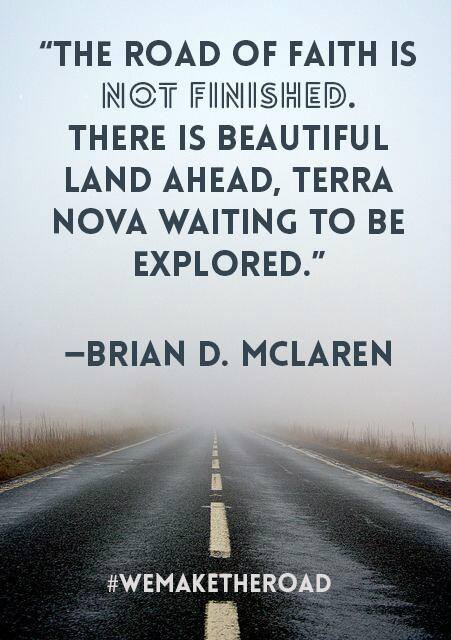
One of the group asked the leader who Brian McLaren is. The answer was factual, and avoided any controversy. Now, I’ve read a few of his books and I was challenged and also supported by them. But McLaren’s hardly uncontroversial; indeed, he’s been labelled a ‘false teacher’ and as someone ‘dangerous’ because he is seen as putting experience above Scriptural revelation, because he doesn’t use masculine pronouns for God, and because he won’t denounce universalism.
When Time magazine included him in their list of the 25 most influential evangelicals in America, it reported that, when asked at a conference in 2004 what he thought about gay marriage, Brian McLaren replied to the question, ‘You know what, the thing that breaks my heart is that there’s no way I can answer it without hurting someone on either side.’ That strikes me as one of the best things yet said on the topic. He estimated that 6% of people are gay, and that at least 30% of the population are affected because a child, a parent, a sibling, a friend is gay.
In 2013, McLaren’s son married another man, and he led a commitment ceremony for the couple. Those who find McLaren dangerous would, I assume, see this as yet another example of him prioritizing experience. But he has written about how his view on human sexuality has changed gradually over three decades. Here are his words:
One of the characteristics I most appreciate about “a generous orthodoxy” or “a new kind of Christianity” is the freedom to stay unified and stay in fellowship even when we disagree.
In terms of how many people’s views on this subject have shifted over the past thirty years or so, he observed that:
It’s much easier to hold the line on the conservative position when nearly all gay people around you are closeted and pretending to be other than they are.
That struck me as a very useful observation. The Church of England’s policy of pretending nothing was going on characterized my experience of church from the local to the national level. Those who were openly gay in other contexts could suddenly become not gay at all when asked for their views on the subject or when speaking in a debate at a synod.
And finally, I find helpful McLaren’s response to those who ask what will change next if we accept the full humanity and human rights of gay people:
I hope we will tackle the elephant in the room, so to speak – the big subject of poverty. If homosexuality directly and indirectly affects 6 – 30% of the population, poverty indirectly and directly affects 60 – 100%. What would happen if we acknowledged the full humanity and full human rights of poor people? And then people with physical disabilities and mental illnesses and impairments? And then, what after that? What would happen if we acknowledged the spiritual, theological, moral value – far beyond monetary or corporate value – of the birds of the air, the flowers of the field, of seas and mountains and valleys and ecosystems? To me, Jesus’ proclamation of the reign or commonwealth of God requires us to keep pressing forward, opening blind eyes, setting captives free, proclaiming God’s amazing grace to all creation.
Posted in Shared Conversations
Tagged Bible, Brian McLaren, evangelicals, experience, marriage, Shared Conversations, synod, universalism
3 Comments
University Isn’t For Men?
Source: University Isn’t For Men?
A very perceptive take on the wider issues of gender. Now reprinted on the Times Higher Education blog, so I’m not the only one who thought so!
Posted in Uncategorized
Leave a comment
Fruit or chocolate?

A few months ago, I was lucky enough to monitor a session of teaching for people working for the Church of England, in which they learned about reconciliation. One of the many exercises involved everyone standing up and then having to move within the room to align themselves with one of two options: for example, fruit, or chocolate? If you identify with ‘fruit’, go to that end of the room. If you identify with chocolate, it’s the other end.
As we all moved around the room, deciding which way to go and how near the wall to locate ourselves, some clearly hated the whole thing. Others were up for anything. Some spent a while working out just where to stand. Others found a place, stood there, and then carefully moved one step further along. None of us really knew why we were doing it. But at each stage, as yet another pair of terms was called out, and we all moved again, the facilitator would ask some people why they stood where they stood. Why fruit rather than chocolate?
Fruit: ‘It’s not that I don’t love chocolate – but I’m diabetic so I shouldn’t eat it’.
Chocolate: ‘I like them both, and in fact I like fruit more, but I thought, if it were to be the last thing I eat in my life, it would be chocolate’.
Fruit: ‘I took the question to be about how much of each I eat in the average week’.
Chocolate: ‘I just love the sound of the word’.
The facilitator also asked people why they thought others were standing where they were. Did the fruit people think the chocolate people were gluttons? Did the chocolate people think the fruit people were all liars, trying to claim a virtue that in reality they lacked?
This exercise demonstrates a very simple set of facts. Not everyone who positions herself as holding a particular belief or view does so for the same reason as others who hold that belief or view. People don’t all hear a question in the same way. It’s not easy to second-guess the motives of others. We all come to any debate with our own assumptions about others, and they in turn make assumptions about us. We come to any debate with our own history.
And thinking in binaries, in polarizations, misses out all the richness of our individuality.
Posted in Shared Conversations
Tagged assumptions, belief, binaries, chocolate, Fruit, reconciliation, Shared Conversations
6 Comments
Glad to be lay
So: I’ve met (briefly) the other people from this diocese with whom I’ll be spending three days next month in the Shared Conversations. The meeting was a simple dinner, at which we moved so we sat with different people for each course. I’m now working under the St Michael’s House protocols, so won’t say anything about the individuals. In terms of the group, all I’d say is that it seems very clerical, although balanced in terms of gender. There are also a lot of members of diocesan synod on it. Both of these factors affect the dynamics, as they mean that some people already know several members of the group, whereas those of us who are laity and have nothing to do with diocesan synod may have no prior knowledge of the others. Whether that’s an advantage or a disadvantage remains to be seen. As it happened, I found that one of those present has a connection to someone I know, but that’s the normal small world thing.
It was interesting to learn that this diocese selected people to take part according to those people offering to do so – the alternative being to nobble people from specific interest groups and ask them to attend. So, we’re all volunteers. That too can affect the dynamics. The bishop sent a message thanking us and saying how helpful he’d found our stories, as told on our applications to join. But in most cases we’ve said nothing to each other about our stories (yet!) so it’s sheer guesswork as to whether someone who seems very congenial thus far will agree or disagree on the issues we’ll be discussing. And that’s as it should be; first, we need to acknowledge each other as people and fellow Christians.
Not for the first time in my life, I was asked whether I am exploring a vocation to ordained ministry. Before women could be ordained, I’d answer that question (which sometimes seems to be addressed to any woman with a bit of gumption!) by saying I didn’t know; it wasn’t an option, so it was rather like asking me ‘Do you feel a vocation to be a rock?’ After the ordination of women became possible, I found my vocation to be laity steadily firming up. I think there’s something very positive about Doing Church Stuff without ordination; I hope it empowers and inspires others to feel they can too. There was a bit of a blip when I felt very strongly that I was being called to something, but wasn’t sure just what. A long period of discernment with a very fine spiritual director and some excellent quiet days in a local convent ended with the decision to train as an authorized lay preacher, and that feels just fine still. So, although I can never rule anything out, I’m lay, and proud. To adapt the lyrics of the Tom Robinson band,
Sing if you’re glad to be lay
Sing if you’re happy that way…
So, one more month before we all meet together for the big event. I think I’m at least looking forward to finding out more about my fellow Conversationalists.
Posted in Uncategorized
Tagged bishop, Diocesan Synod, gender, ordination, selection, Shared Conversations, St Michael's House protocols
Leave a comment
 sharedconversations