
In my previous post I mentioned that point where we found out the conservative groups were down to meet the LLF team before the House of Bishops met on 9 October, and the progressive groups after. As, in the end, nothing we said seems to have made any difference to the unexpected ‘pulling the B2 rabbit out of the mitre’ at that meeting of the House, maybe there wasn’t anything sinister going on with our invitations. Or maybe there was, but the key thing was not when we were down to meet the LLF team, but when the conservatives were? But there’s something else which has since occurred to me: it’s the revealing readiness in my mind, and in the minds of the others in the progressive groups, to assume that something is wrong about having all the conservative groups scheduled to meet before the bishops and all the inclusive groups after. Should we call that ‘the hermeneutic of suspicion’? It’s churchy language, at least.
I can now add another example of how suspicious and fearful we currently are. On Friday night, I was having my first attempt at reading GS2328, but in dodgy light on a small screen. When I came to 2.1.1 of the draft Pastoral Guidance, on ‘Making transparent decisions locally’, I thought that it meant that any occasion when the Prayers are to be used in a normal service would have to be notified in advance: the wording is that the incumbent’s decision to use them should be discussed with the PCC and the wider congregation and “made known ahead of time”. So I tweeted “so, if the vicar is going to use the Prayers of Love and Faith during the Sunday service, they are advised to put out a warning in advance?! We don’t routinely pre-warn about who is preaching or which intercessions or Eucharistic prayer we are using or what the hymns are…”
Re-reading the next day, in better light on a larger screen, I concluded that I’d read this wrong, so put up a further tweet, “may have misread a section of that very long GS2328. The phrase I took to mean announcing before a service that the Prayers would be in use was ‘made known ahead of time’. Maybe it just means ‘ahead of anyone actually asking for the Prayers’? My apologies if so.” Because I want to get this right; although I’m not yet sure that I have done so. Here’s the screenshot of the relevant section.
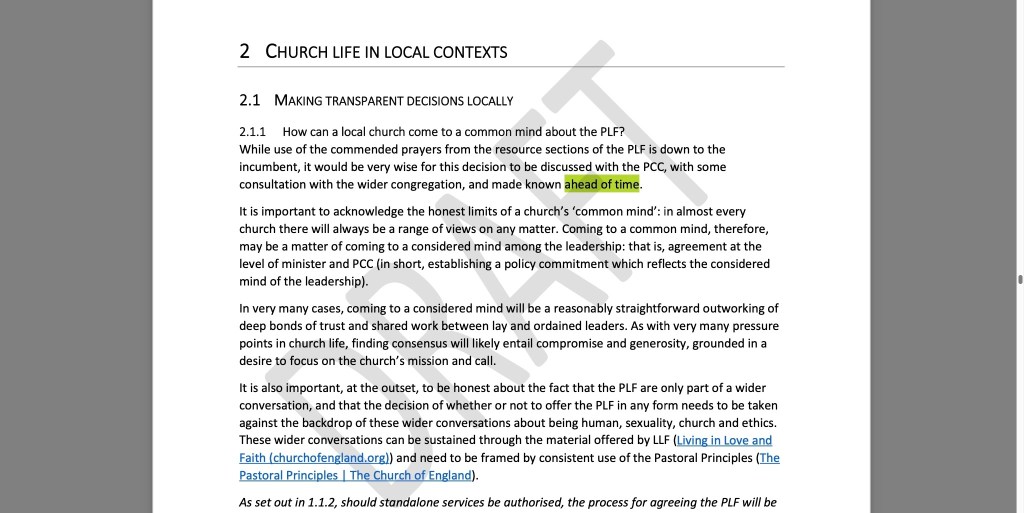
What interests me was how willing people were to accept my initial (mis?)reading suggesting that ‘health warnings’ would be issued ahead of using the Prayers in any normal service. In tweets and messages, some people reminded me that there are parishes where they do indeed announce who is preaching at each service, or who is presiding. Personally, I don’t think it should matter; preaching isn’t a celebrity performance and I certainly don’t attend for the preacher. Who’s presiding, though, that’s something else – in a situation where some people in a parish or a team won’t accept communion from a woman, telling them that the Revd Susan Smith is presiding means they can go elsewhere. Personally, I think that’s very sad, and I also wonder how far it goes; in my own parish there used to be someone who would not even take the Host (consecrated by a man) from a woman communion assistant, although he would take the chalice from a woman. I asked him why but the explanation didn’t go beyond how he just wasn’t happy about it.
Beyond that, though, the way a suggestion of a health warning ahead of any use of the Prayers was seen by many as perfectly likely reflects the low expectations which are set by GS2328. It’s all about fear; conservative fear that – to give just one example – a lay member of the church will be picked on at work because they belong to a congregation that won’t use the Prayers. Or, to give another example, that people coming for the Prayers will wear clothes that look too wedding-y. Or that churches – apparently allowed to design their own not-a-marriage-really certificate, may include symbols that look too wedding-y (“Such certificates must not suggest or imply in their wording or design that they commemorate or are proof of a marriage” in 1.3.4: imagine the drafting of that sentence… ‘ooh, add “or design” because even if the wording is OK there may be a picture of a cake’).
All this reflects the prevailing mood. Any sense of joy, of celebration, of welcome, of blessing, has now disappeared. In its place there’s just a combination of conservatives trying to present this as gaining the maximum possible protection from a Bad Thing (in their words, ‘blessing sin’): and progressives convinced that any crumb they are given will be hedged around to make it as depressing as possible. In this climate of increasing fear, where is the faith that sets us free?

 sharedconversations
You are absolutely right about the atmosphere surrounding this whole exercise. Gone are any positives from the Pastoral Principles and engagement in LLF groups. This is now a fight by any other name. Inclusive people need to recognise that and organise around a very simple and clear platform. Changed canon, and equal marriage. The Canon on Marriage is a law, not a doctrine. Marriage is no part of the Catholic creeds, and only appears in the 39 Articles in relation to clerical marriage being a conscientious matter. Canons change all the time. We must present this as a widening of church law and resist having it categorised as a doctrinal matter.
LikeLike
Pingback: Reactions to latest LLF proposal | Thinking Anglicans
Pingback: Church of England plans to bless but not confirm S...... | News and reporting | Nill Games
Pingback: Church of England Advances Plans to Bless but Not Affirm Same-Sex Couples
Pingback: Church of England Expands Plans to Offer Blessings Without Affirmation of Same-Sex Relationships | News & Reporting – CCC NEWS
Pingback: चर्च ऑफ इंग्लैंड ने आशीर्वाद देने की योजना को आगे बढ़ाया लेकिन एस की पुष्टि नहीं की…… | समाचार à¤
Pingback: Church of England Advances Plans to Bless but Not Affirm S...... | News & Reporting - My Catholic Country
Pingback: Church of England Moves Forward with Blessing but Not Affirmation of Same-Sex Relationships | News & Reporting – CCC NEWS
Pingback: Church of England Advances Plans to Bless but Not Affirm S...... | News & Reporting - End Times Buzz
Pingback: Church of England Advances Plans to Bless but Not Affirm Same-Sex Couples - Nashville News Source
Pingback: Iglesia de Inglaterra avanza planes para bendecir pero no afirmar a S...... | Noticias y reportajes - Oraciones Cristianas
Totally agree with all your general thoughts Helen. However, in the wording you highlight, I think they mean if the Incumbent wants to be a church that uses the prayers from PLF, he/she would be wise to discuss this decision with the PCC and then inform the wider congregation of this policy decision. So the congregation and the PCC should all be on board or the dust settled before the first service they are ever included and it is not sprung on them then during the service that we are a church going to use PLF! At least that’s how I read it. I think because it is stating what you would hope is the obvious, it becomes not clear!
LikeLike
I find it very concerning however that the Bishops would choose to meet with one group before their meeting and another group after. I’m sure it’s the nature of things to be swung by the first group, and all your discussions influenced by the points they raise. However, does it mean that actually they know they are really going the liberal/progressive direction so don’t need to meet with you first, and seeing the conservatives first they can try smooth things over as much as possible…?
LikeLike